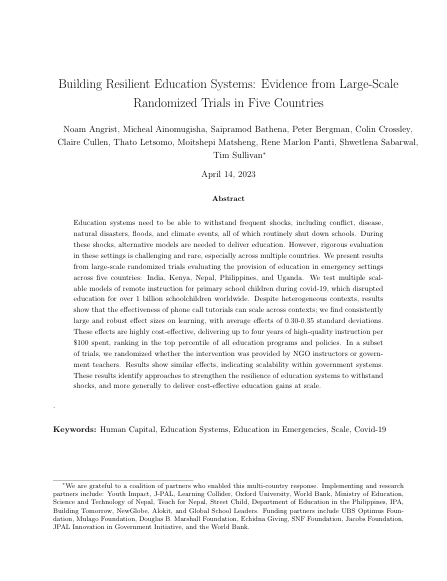
Education systems need to be able to withstand frequent shocks, including conflict, disease, natural disasters, floods, and climate events, all of which routinely shut down schools. During these shocks, alternative models are needed to deliver education. However, rigorous evaluation in these settings is challenging and rare, especially across multiple countries. We present results from large-scale randomized trials evaluating the provision of education in emergency settings across five countries: India, Kenya, Nepal, Philippines, and Uganda. We test multiple scalable models of remote instruction for primary school children during covid-19, which disrupted education for over 1 billion schoolchildren worldwide. Despite heterogeneous contexts, results show that the effectiveness of phone call tutorials can scale across contexts; we find consistently large and robust effect sizes on learning, with average effects of 0.30-0.35 standard deviations. These effects are highly cost-effective, delivering up to four years of high-quality instruction per $100 spent, ranking in the top percentile of all education programs and policies. In a subset of trials, we randomized whether the intervention was provided by NGO instructors or government teachers. Results show similar effects, indicating scalability within government systems. These results identify approaches to strengthen the resilience of education systems.