
Figure 1: Opening slide of the session
Since the TEN (Transforming Evidence Network) Conference in Cape Town in late 2024, monthly TEN Learning Sessions have continued to gather a global community of researchers, practitioners, and policymakers around one shared question: how can we make research more useful in real life? These sessions go beyond sharing findings, they are moments of collective learning, critical reflection, and practical exchange. They offer a space to test new approaches and strengthen the connection between evidence, policy, and everyday action.
The May session embodied this vision. It featured eBASE Africa, who brought something refreshingly different to the TEN space: Tori Dey, an evidence-based storytelling approach rooted in African oral traditions.
If you were in Cape Town, you likely remember how eBASE opened the conference, not with slides or a keynote, but with a live story. Through song, rhythm, performance, and emotion, they captured what many had long struggled to articulate: the disconnect between what research tells us and what communities experience, and how storytelling can bridge that gap.
This moment of resonance set the stage for May’s deeper dive, where eBASE unpacked not just the philosophy behind Tori Dey, but its structure, process, and potential to transform how evidence is communicated and used. As Aaron Stanley (the moderator), standing in for Pew Charitable Trusts, reminded the group: TEN is not only about collecting evidence but also about improving how it travels, how it reaches people, influences decisions, and ultimately shapes lives. Tori Dey is doing exactly that.
“The power in this is in the group—not just in the presenters. This is your space.”
— Learning Session Host
What Tori Dey Is (and Isn’t)
The conversation led by Patrick Okwen, Ntam Damaris, and Nange Lisette didn’t just describe storytelling, it walked participants through how it works, why it matters, and what makes it different.
Tori Dey is not just “development storytelling.” It emerged in response to a very real problem: research evidence, while abundant, rarely reaches the people it is meant to serve.
Typically, evidence travels upwards, into policy briefs and technical guidelines aimed at decision-makers. Communities are left out, unable to access, understand, or use the insights that concern their own lives. This creates what eBASE calls an asymmetry of knowledge, where information sits with those in power, while citizens remain disconnected from it.
Tori Dey, Pidgin English for “Let’s tell stories”, was developed to close that gap. It’s a structured, seven-step process that translates complex research findings into emotionally resonant, culturally rooted stories, delivered in the formats and languages that people relate to.
It starts with identifying a topic, for example, iron supplement uptake from a health report. Then, using behavior change tools like the trans-theoretical model, eBASE assesses the community’s readiness for change. Are they unaware? Resistant? Ready to act? This diagnosis shapes the tone and approach of the story.
Once the evidence is summarized in simple terms, local storytellers are brought in, not as performers, but as co-creators. They draw on lived experience, humor, and local language to craft stories grounded in data. These are then shared through community gatherings, radio, drama, or social media, not as one-off messages, but as part of a feedback loop.
What makes Tori Dey different is that storytelling is the method, not the medium. It’s how knowledge is translated, mindsets shifted, and trust rebuilt, especially in contexts where research is often viewed with suspicion or is inaccessible due to language, cost, or literacy barriers.
And it’s not static. The method evolves, incorporating AI to support transcription, story synthesis, and data tracking. But it stays true to its roots: stories told with people, not about them.
“We’ve impacted millions in Africa using this method, but we’re just getting started.”
— Patrick Okwen
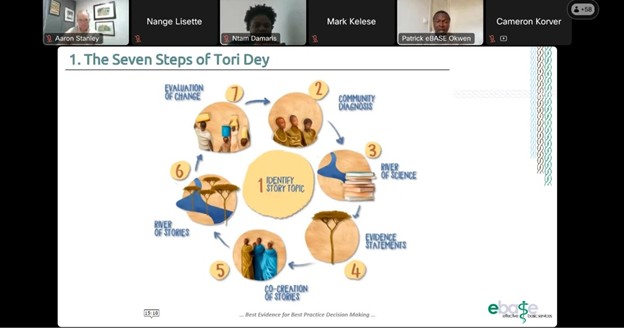
Figure 2: Session screenshot highlighting the slide presenting the structured seven-step process of the Tori Dey method.
Highlights from the Session
- Stories as evidence, not just packaging: Tori Dey treats stories as core evidence outputs, capturing how communities perceive and respond to change.
- Co-creation as a principle: Storytelling is developed with local actors who know the community context, language, and realities best.
- Two-way sharing: Audiences are also sources of insight. Their reactions and reflections help refine the stories and the data behind them.
- Real impact in real places: In conflict-affected areas like Bamenda, Tori Dey has shifted mindsets around gender-based violence, leading to more community protection and access to services.
What We’re Still Figuring Out
The conversation didn’t shy away from challenges:
- Storytelling approaches still struggle for recognition within traditional academic and funding systems.
- Peer-reviewed journals often exclude creative, community-generated outputs.
- Funders may be hesitant to invest in what feels less measurable or familiar.
But spaces like TEN are making a difference, offering room to question, try new things, and learn from what’s already working, even if it doesn’t fit the mould.
Key Takeaways for the TEN Community and the Global Evidence Ecosystem
- Research doesn’t always move people, but stories often do.
- Emotional connection and scientific rigor can co-exist.
- Communities must be part of how evidence is created, communicated, and acted upon.
- AI can support, not replace, human-centered storytelling approaches.
- We need more spaces like TEN to safely test, question, and share these practices.
A Call to Act Differently
To the TEN community and everyone shaping the future of evidence:
If we want research to matter, we must look beyond the numbers. Let’s keep making room for methods like Tori Dey, methods that invite people in, not shut them out. That speak to real life, not just policy. That connect the rigor of science with the richness of story.
Support approaches that value both data and dialogue. That treat storytelling as a process of inclusion, not just communication. That remind us: knowledge must not only be generated, it must be felt, trusted, and used.
As one participant reflected,
“You don’t often see a room on its feet after a research session. But when evidence speaks like this, people don’t just hear it—they feel it.”
Let’s build more of that. Together.
About the author: Elanga Andrea, hailing from Yaoundé, Cameroon, is a multilingual individual fluent in French, English, and Bulu. As the Communications Officer at Effective Basic Services (eBASE) Africa, she plays a pivotal role in improving the livelihoods of underserved populations in Cameroon, Niger, Chad, and Nigeria through innovation and best practices.
Her expertise extends beyond communication, reaching into global evidence networks. She actively participates in the Cochrane Collaboration, the Joanna Briggs Collaboration, and the Africa Evidence Network (AEN).
Elanga Andrea has been a passionate advocate for World Evidence-Based Health Care Day since its inception and has contributed to developing the AEN Capacities Community of Practice.
Acknowledgements: The author is solely responsible for the content of this article, including all errors or omissions; acknowledgements do not imply endorsement of the content. The author is grateful to Charity Chisoro and Julius Fenji for their guidance in preparing and finalising this article, as well as their editorial support.
Disclaimer: The views expressed in published blog posts, as well as any errors or omissions, are the sole responsibility of the author/s and do not represent the views of the Africa Evidence Network, its secretariat, advisory or reference groups, or its funders; nor does it imply endorsement by the afore-mentioned parties.
Suggested citation: Elanga A (2025) eBASE Africa at the May TEN Learning Session: Highlights and Reflections from the Tori Dey Conversation. Blog posting on 20 June 2025. Available at: https://africaevidencenetwork.org/ebase-africa-at-the-may-ten-learning-session-highlights-and-reflections-from-the-tori-dey-conversation/2025/06/20/