
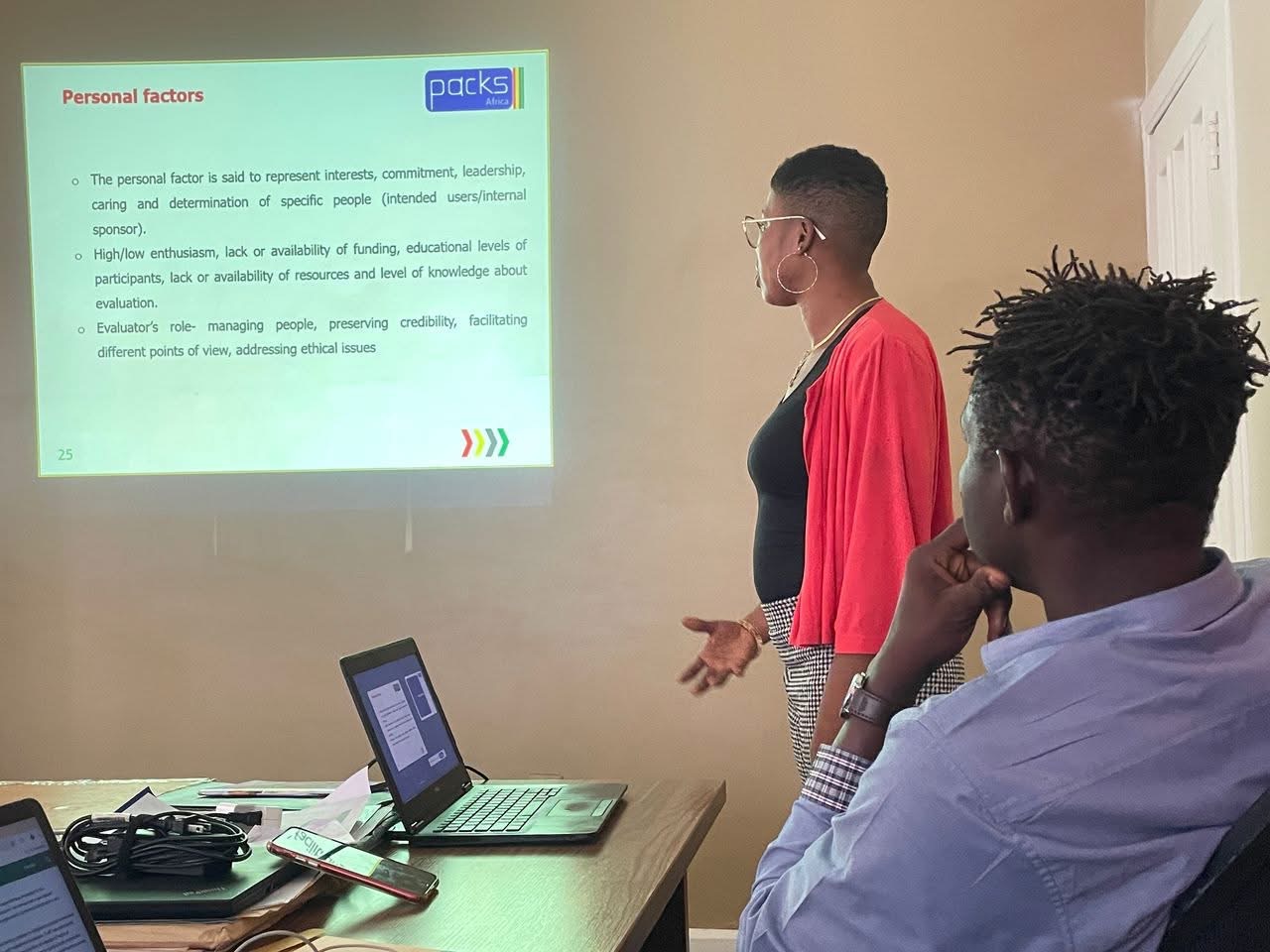
Monitoring and Evaluation (M&E) data is not just about metrics or reporting obligations. It’s about empowering stakeholders to make informed, timely, and meaningful decisions. Against this backdrop, the PACKS Africa team came together for a powerful internal learning session led by Dr. Marvis Bih, Monitoring, Evaluation, and Learning (MEL) & Knowledge Management Lead at PACKS Africa.
The seminar started with a deep reflection on how M&E data can shape decision-making, inspire organisational learning, and promote accountability (Bih, 2021). Referencing the work of Patton (2012; 2008), Dr. Bih outlined six key purposes of programme monitoring and evaluation:
- Assessing the value of the programme,
- Facilitating improvement and learning,
- Ensuring accountability,
- Tracking progress through monitoring,
- Supporting developmental use, and
- Generating knowledge.
Each of these purposes calls for a different type of thinking and action, ranging from deciding whether to continue a programme to using lessons learned for future planning.
One of the most illuminating parts of the seminar was Dr. Bih’s focus on the “process” or “conceptual” use of evaluation (Bih 2021; Podems 2019; Weiss 1998; Shulha & Cousins 1997). Often, evaluations are judged solely by their findings, but the act of participating in evaluation — asking questions, interpreting data, reflecting on outcomes — can be equally transformative.
Dr. Bih stressed that when staff actively engage in the evaluation process, it helps build a culture of evaluative thinking. From pre- and post-assessment forms to collaborative data analysis, every interaction with M&E can reinforce learning and ownership. These processes support better programme implementation and deepen internal understanding and trust.
Through examples and discussions, the team shared practical examples on how embedding evaluation into daily routines can elevate an organisation’s overall culture. Making a case that when evaluative thinking becomes second nature, teams become more responsive, adaptive, and aligned toward common goals.
For instance, Dr. Bih explained how intentional data collection tools, like feedback forms used during training sessions, can go beyond data capture to signal learning, accountability, and improvement. Evaluation then becomes not an afterthought, but an integral part of strategic and operational planning.
In the context of political and personal factors, Dr. Bih pointed out that data doesn’t exist in a vacuum — and neither does its use — highlighting the critical need to acknowledge the political and personal factors that influence how M&E data is interpreted and acted upon.
She elaborated that political dynamics such as competing stakeholder interests or organisational power structures can shape whether data is embraced or resisted. Similarly, personal factors like leadership support, resource availability, or individual enthusiasm can dramatically affect the success of M&E initiatives. Recognising and navigating these forces is crucial for any data-driven organisation.
A Call to Action: Make M&E Everyone’s Responsibility
The seminar closed with a strong call to action: to fully realise the value of M&E, we must go beyond technical implementation and embed it into the ethos of our work. Dr. Bih urged all PACKS Africa staff and the Evidence Informed Decision Making (EIDM) ecosystem to view M&E not as a standalone function but as a collective responsibility that informs, empowers, and inspires.
“Integrate evaluative thinking in everything you do,” she said. “When M&E is embedded in the culture, it drives continuous learning, accountability, and ultimately, impact.”
As an organisation committed to strengthening the use of evidence in policymaking across Africa, PACKS Africa understands that knowledge alone is not enough — its thoughtful application is what creates change. Thus, let’s continue championing evaluation as a compliance requirement and a strategic resource for growth, reflection, and excellence.
About the author: Divine Adongo is a Strategic Communications Specialist at PACKS Africa, an Emerging Public Leaders Fellow, and President of the Centre for Contemporary Pan-Africanism. He is currently pursuing a Bachelor of Laws. He holds a Higher National Diploma in Media and Communications Studies from Tamale Technical University, a Bachelor of Arts in Communications with a specialisation in Public Relations, and a Master of Arts in Political Communications Management from the University of Media, Arts, and Communications (UniMAC). His interests include writing, law, diplomacy, policy, politics, and governance.
Acknowledgements: The author(s) is solely responsible for the content of this article, including all errors or omissions; acknowledgements do not imply endorsement of the content. The author is grateful to Kirchuffs Atengble and Dr. Marvis Bih for their guidance in preparing and finalising this article, as well as their editorial support.
Disclaimer: The views expressed in published blog posts, as well as any errors or omissions, are the sole responsibility of the author/s and do not represent the views of the Africa Evidence Network, its secretariat, advisory or reference groups, or its funders; nor does it imply endorsement by the afore-mentioned parties.


