
Introduction
The #LivingTheManifesto Challenge was launched by the Africa Evidence Network (AEN) to showcase how members across Africa are applying the Manifesto on Capacity Development for Evidence-Informed Decision Making (EIDM) in their work. Implemented between June and September 2025, the campaign invited ecosystem actors to share stories (written, visual, and multimedia) that demonstrate the Manifesto’s principles in practice.
This reflection brief examines how the campaign itself embodied the AEN Manifesto’s core values: inclusivity, equity, collaboration, contextualisation, and decoloniality. It highlights key processes, outputs, and lessons from the challenge, illustrating how the Manifesto’s philosophy was lived out through participatory storytelling and collective learning.
Our Foundation: Decolonial Principles in Practice
The #LivingTheManifesto Challenge was grounded in decolonial principles that prioritise African knowledge, experiences, and perspectives.
A total of 14 entries were received, reflecting a wide diversity of actors that range from submissions by individual actors to those by international organisations. Customised feedback was given to each submission, and where necessary, support was offered to improve the submissions. Twelve of these submissions were reproduced in video formats, complementing the storytelling experience. No entry was rejected for any reason, demonstrating a Manifesto value of collaboration and co-creation.
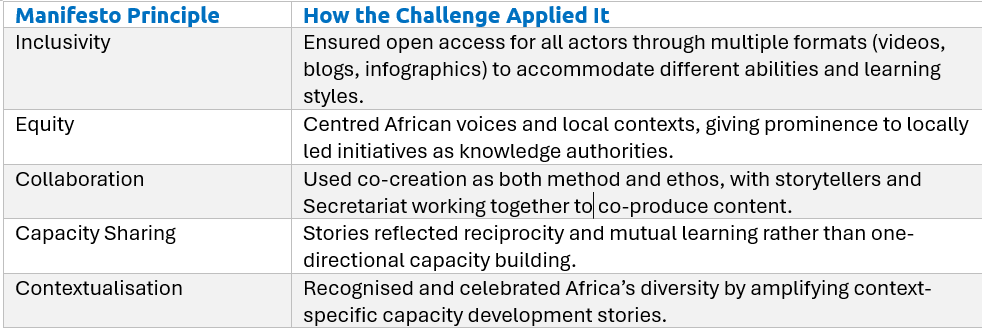
The campaign operationalised several core Manifesto principles as follows:
From Idea to Action: Implementing #LivingTheManifesto
The campaign moved from concept to practice through storytelling, crowdsourcing, and partnerships. It positioned African practitioners as narrators of their own experiences, replacing extractive documentation with self-representation.
A key output was the creation of a digital repository of lived experiences. Through the #LivingTheManifesto Video Storytelling Series, hosted on AEN’s YouTube playlist, members shared how they are living the Manifesto’s principles across Africa’s evidence ecosystems. These videos demonstrate African-led initiatives, diverse epistemologies, and decolonial storytelling, forming an evolving, open-access repository of Africa’s capacity stories. Standardised forms of these narratives are equally published in text forms here:
Outputs of the Challenge
The challenge generated a range of tangible and relational outputs that embody the Manifesto’s principles:
- Knowledge Outputs:
- A curated collection of multimedia stories demonstrating Manifesto principles in action.
- The #LivingTheManifesto YouTube playlist as a public archive of lived experiences.
- Digital artefacts such as infographics, visuals, and story excerpts disseminated across AEN platforms.
- Relational and Institutional Outputs:
- Strengthened relationships across AEN’s membership base, fostering mutual visibility and trust.
- Enhanced storytelling capacity within AEN and partner organisations.
- Expanded partnerships with local institutions, youth networks, and civil society groups.
- Conceptual Outputs:
- Recognition of storytelling as a decolonial methodology in EIDM capacity work.
- Evidence that capacity development can occur through narrative exchange.
- A participatory reflection framework replicable for future AEN initiatives.
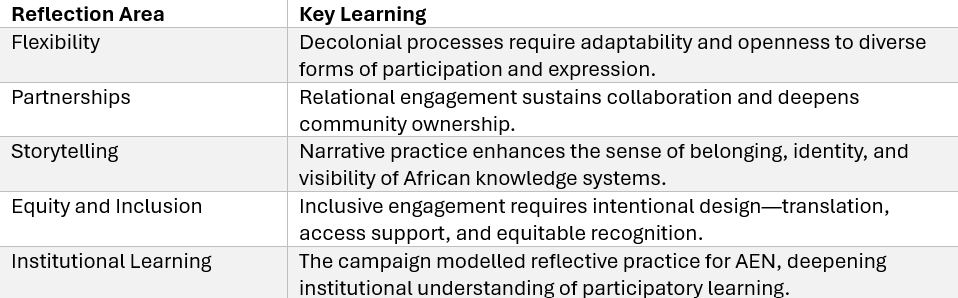
Reflecting on the Process: What We Learned
Reflecting on the campaign’s journey, several key lessons emerged:
Emerging Implications for AEN’s Practice
The #LivingTheManifesto Challenge revealed that storytelling is more than communication: it is a form of capacity development that fosters reflection, connection, and ownership. From now on, AEN can deepen decolonial communication by privileging African languages, imagery, and knowledge forms in all engagements, ensuring that African epistemologies remain visible and valued.
The experience also emphasised the need to institutionalise co-creation across AEN’s programmes. Inviting members as collaborators, rather than participants, strengthens mutual accountability and makes partnerships more sustainable. The stories generated offer valuable insights to inform future revisions of the AEN Manifesto, particularly in terms of accessibility, localisation, and technological inclusion.
The AEN should also embed reflective systems, for example, learning diaries or periodic storytelling reviews, to capture everyday learning across its Secretariat and network. Finally, intentional inclusivity must remain central: providing translation, facilitation, and small grants can ensure equitable participation from underrepresented groups.
Overall, the challenge affirms that AEN’s greatest strength lies in modelling its own principles: continuously living the Manifesto through African-led, participatory, and context-sensitive practice.
Conclusion: Living the Manifesto, Moving Forward
The #LivingTheManifesto Challenge transformed reflection into practice by allowing Africans to narrate their capacity journeys in their own voices. Its digital outputs, particularly the YouTube playlist, stand as a living archive of the Manifesto in action, embodying the principles of equity, inclusivity, contextualisation, and African agency.
The process itself became the product, demonstrating that capacity development in Africa must be experienced, narrated, and owned by Africans themselves.
“Transformation is only valid if it is carried out with the people, not for them.” – Paulo Freire.
The #LivingTheManifesto Challenge has been a powerful experience for us, and we are grateful to our members and partners who have shared their stories and experiences with us. We hope that this campaign will inspire others to take action and continue to build a stronger evidence ecosystem in Africa. We invite you to join us in this journey, sharing your story of how you’re living the Manifesto. Together, we can co-create a collective narrative around the importance of capacity development in Africa and inspire transformative change.