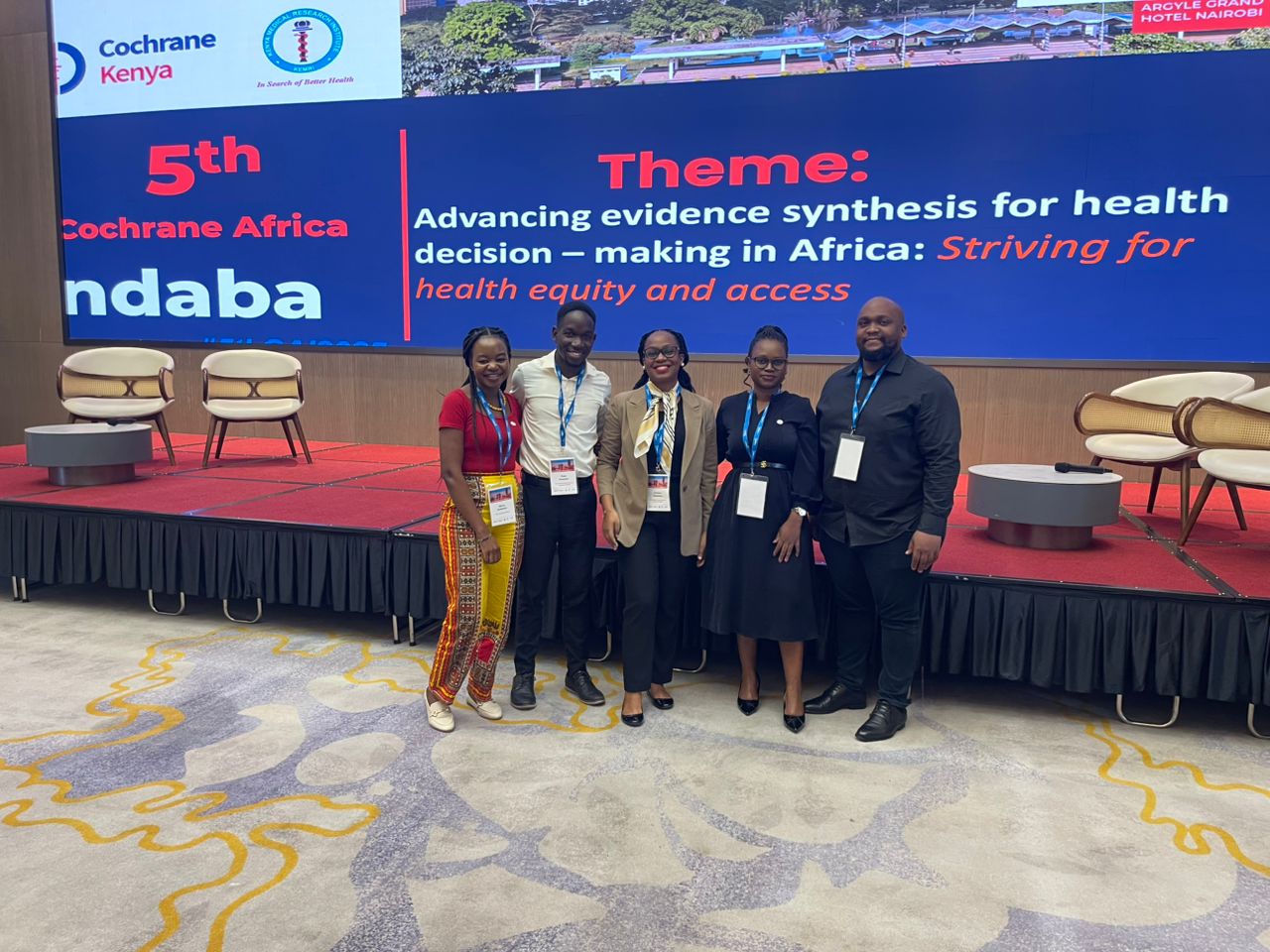
The Africa Evidence Network was proud to participate in the Cochrane Africa Indaba 2025 in Nairobi, where thought leaders gathered to innovate in evidence synthesis for health decision-making. Our members had the opportunity to engage with experts, share experiences, and reflect on the implications for promoting evidence-informed decision-making across Africa. In this blog post, we share personal reflections from the conference by members of the AEN secretariat – Nkululeko Tshabalala and Gloria Anderson, highlighting key takeaways and insights that can inform our work in the evidence ecosystem.
Cochrane Africa Indaba 2025: A Reflection by Gloria Anderson on Innovation in Evidence Synthesis
Last week, I had the privilege of attending the Cochrane Africa Indaba 2025 in Nairobi, representing the Africa Evidence Network. Among the many enlightening sessions, one that particularly resonated with me was Plenary 4: Innovation in Evidence Synthesis for Health Decision-Making. This session featured thought leaders like Karla Soares Weiser (Editor-in-Chief, Cochrane), Patrick Okwen (Team Lead, eBASE Africa), and Ruth Stewart (Director, Alliance for Living Evidence – ALIVE).
Alive or Dead? A New Approach for Driving Evidence-Informed Action
Ruth Stewart’s presentation, titled “Alive or Dead? A New Approach for Driving Evidence-Informed Action”, introduced the concept of “living evidence partnerships.” This approach challenges the traditional static models of evidence synthesis, advocating for a dynamic, continuously updated system that remains relevant and actionable.
The core idea is that evidence should not be a one-time product but a living entity that evolves with new data and insights. This model emphasizes:
- Continuous Updating: Ensuring that evidence remains current and reflective of the latest research.
- Collaborative Production: Engaging stakeholders from various sectors to co-create and validate evidence.
- Timely Dissemination: Delivering evidence to decision-makers when it’s most needed, enhancing its impact.
The ALIVE Model: Revolutionising Evidence Synthesis
The Alliance for Living Evidence (ALIVE) embodies this innovative approach. Their model focuses on:
- Living Production: Maintaining up-to-date evidence through continuous synthesis, ensuring relevance and applicability.
- User Collaboration: Engaging evidence users in the synthesis process, making it more affordable and tailored to specific needs.
- Supply Coordination: Streamlining evidence production to avoid duplication and enhance trustworthiness.
- Enhanced Impact: By improving the quality and timeliness of evidence, ALIVE aims to amplify its influence on policy and practice.
This model addresses the common pitfalls of traditional evidence synthesis, such as outdated information and lack of stakeholder engagement, by fostering a more responsive and inclusive process.
Implications for the Africa Evidence Network
As a member of the Africa Evidence Network, Ruth Stewart’s insights are particularly pertinent. The ALIVE model aligns with our mission to promote evidence-informed decision-making across Africa. By adopting a living evidence approach, we can:
- Enhance Responsiveness: Quickly adapt to emerging challenges and provide timely evidence to policymakers.
- Foster Collaboration: Engage a broader range of stakeholders in the evidence synthesis process, ensuring diverse perspectives and needs are considered.
- Improve Accessibility: Make evidence more readily available and understandable to those who need it most.
Reflections and Takeaways
Attending this session reinforced the importance of evolving our approaches to evidence synthesis. The dynamic nature of the ALIVE model offers a promising path forward, especially in contexts where timely and relevant evidence is crucial for decision-making.
Moreover, the emphasis on collaboration and continuous updating resonates with the challenges we face in the African context, where rapid changes and diverse needs require adaptable and inclusive evidence systems.
Looking Ahead
The Cochrane Africa Indaba 2025 was a testament to the ongoing efforts to innovate in the field of evidence synthesis. Ruth Stewart’s presentation on the ALIVE model offers a compelling vision for the future—one where evidence is not just produced but lived, continuously evolving to meet the needs of those it serves.
As we move forward, integrating such models into our work within the Africa Evidence Network can enhance our impact and ensure that evidence remains a vital tool for informed decision-making across the continent.
Double Shot of Nairobi: A Summary of Two Unforgettable Days by Nkululeko Tshabalala
The Unforgettable Experience
We’ve just returned from Nairobi, and honestly, I’m still riding the high (and possibly still recovering from the constant stream of good food and even better company). The conference delivered on every front — a beautiful blur of new faces, old friends, bold ideas, deep laughs, thoughtful debates, and yes — a full Cochrane story arc from beginning to end (big kudos to the storytellers who brought it to life!).
Growing Our Community
Over the course of two incredible days, we had the joy of persuading many wonderful people to join the Africa Evidence Network. We persuaded many with candy and some LinkedIn content though!
The Human Side of Impact
What stuck with me most was the deep humanity that wove through every conversation at our stand. We were there to talk about impact — but it quickly became clear that impact isn’t just about indicators, GANTT charts, and logframes. It’s about people. Real people. The ones we all work so hard, in our various ways, to serve.
A Spirit of Collaboration
There was something so refreshing in the vulnerability we saw and shared — in moments where someone said “I don’t know,” only to be met with “me neither, but let’s figure it out together.” That spirit of collaboration and curiosity reminded me why we need the evidence ecosystem in Africa to thrive — because none of us has the full picture alone.
More Than Just a Conference
This wasn’t a gathering to tick boxes. It was a space. For stories. For nuance. For real talk. For humour. For connection. I bumped into people I hadn’t seen in years, and met others I felt like I’d known forever. Nairobi brought us together — but it was the incredible people at the Cochrane Africa Indaba who made it unforgettable.
A Heartfelt Thank You
To everyone who shared their story, who made space for others, who brought warmth, laughter or a reflective pause — thank you. To the organisers who created such a generous and vibrant space — you nailed it. And to those who stopped by our stand for a chat or a chuckle — you reminded us why this work matters. This wasn’t just a conference. It felt like community. And we can’t wait for what comes next.
Reflections and Takeaways
As I reflect on the experience, I’m reminded that our work in evidence-informed decision-making is not just about data and research, but about people and relationships. The connections we made, the stories we shared, and the laughter we enjoyed are just as important as the ideas we discussed. The conference reinforced the importance of collaboration, curiosity, and vulnerability in driving meaningful impact. We’ll carry these lessons with us as we continue to build the Africa Evidence Network and work towards a future where evidence informs decision-making across Africa.
Until Next Time
Until next time, Nairobi. We’ll back — probably with a long list of fun activities to do!
Looking Ahead
As we reflect on the unforgettable experience of Cochrane Africa Indaba 2025, we’re excited to build on the momentum and connections made in Nairobi. We’ll continue to nurture the relationships forged and harness the collective energy to drive evidence-informed decision-making across Africa. With a renewed sense of purpose and community, we’re eager to tackle the challenges ahead and make a meaningful impact in the lives of those we serve. The Africa Evidence Network will keep thriving, and we can’t wait to share our journey with you.
About the authors:
Gloria Anderson is the Founder and Executive Director of Tanzania Enlightenment Development Innovations (TEDI), a non-governmental organisation dedicated to improving the quality of education in Tanzania by integrating practical skills into the educational system. Under her leadership, TEDI provides programs such as entrepreneurship and employability skills training and digital literacy initiatives. One of her notable projects, “One Computer Lab One School,” aims to establish computer labs in under-resourced public schools, equipping students and teachers with essential computer skills, including e-learning and e-teaching through educational tools, e-libraries, and e-platforms.
In addition to her role at TEDI, Gloria manages stakeholders and communities of practice at the Africa Evidence Network. Her expertise in stakeholder engagement and community development enhances her ability to drive impactful initiatives and foster collaboration within the network.
TEDI was founded based on evidence from a research study conducted by Gloria on graduates’ perceptions of the contribution of university education to employability in Tanzania. The study revealed a significant gap between theoretical knowledge provided by the education system and the practical skills required in the job market and business environment, with 66% of graduates reporting a lack of soft skills. Gloria believes the key to Africa’s development is generating and utilising evidence to drive transformational impacts.
Nkululeko Tshabalala is a Programme Manager at the Pan-African Collective for Evidence (PACE).
Acknowledgements: The authors are solely responsible for the content of this article, including all errors or omissions; acknowledgements do not imply endorsement of the content. The author is grateful to Charity Chisoro for her guidance in preparing and finalising this article, as well as her editorial support.
Disclaimer: The views expressed in published blog posts, as well as any errors or omissions, are the sole responsibility of the author/s and do not represent the views of the Africa Evidence Network, its secretariat, advisory or reference groups, or its funders; nor does it imply endorsement by the afore-mentioned parties.
Suggested citation: Anderson G and Tshabalala N (2025) Beyond Tokenism: Keeping Evidence Alive: Reflections from the Cochrane Africa Indaba 2025. Blog posting on 20 May 2025. Available at: https://africaevidencenetwork.org/keeping-evidence-alive-reflections-from-the-cochrane-africa-indaba-2025/2025/05/20/


