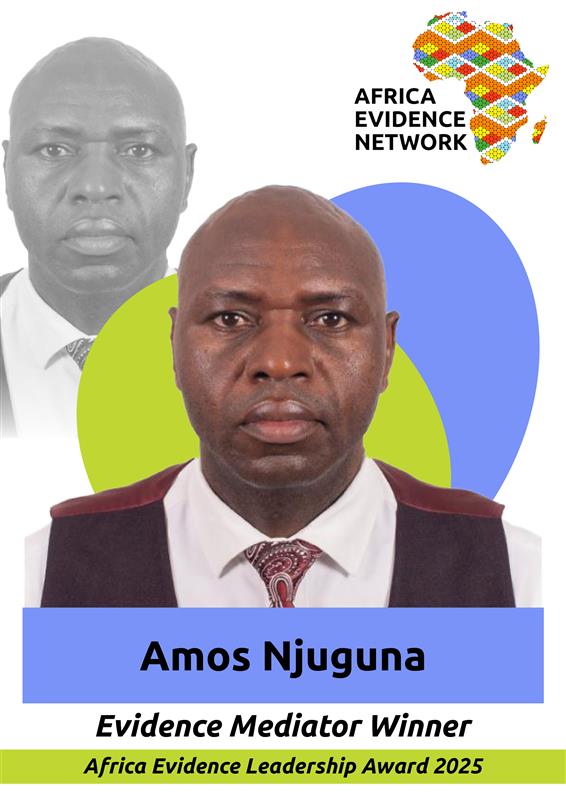
Amos Njuguna is the recipient of the Africa Evidence Leadership Award 2025 in the Evidence Mediator category offered by the Africa Evidence Network. We asked Amos to reflect on his work.
Over the years, I have learnt a lesson: evidence only matters when it speaks to real people, in real contexts, and drives real change to the communities most affected by the challenges we seek to understand. As a researcher, policy advocate, and evidence mediator, I’ve come to believe that evidence must influence policy, empower communities, and guide Africa toward inclusive development. This belief has been shaped by practice through projects, partnerships, and persistent attempts to bridge the gap between data and decisions.
Turning Evidence into Opportunity
Through initiatives like the Africa Impact Academy (AIA), we set out to understand what truly works in supporting youth and women-led SMEs across Kenya, Nigeria, and South Africa. What is emerging is a lesson in humility. Entrepreneurial support must be contextual, data-driven, and consistent. Every country is different, and a one-size-fits-all approach does not work.
The same spirit drove our work in the CO-CARE programme, where we focused on job creation for youth in Kenya’s creative economy. This sector, often underestimated, has immense potential for job creation. To harness the potential, decent work systems must be designed to remove the barriers young creatives face. Our publication with Salome Asena and Jennifer Nyakinya shows how targeted interventions, from mentorship to market access, can turn talent into livelihood, increase incomes of creatives by up to 20%, improve well-being and enhance decent jobs. The lesson? Creativity is not a side hustle; it’s a pathway to dignity and economic inclusion.
Let Africa Lead – Evidence, Research, and the Power of Local Knowledge
Leading the Network of Impact Evaluation Researchers in Africa (NIERA) has demonstrated the power of African expertise. Our continent is home to brilliant minds. When we bring them together, we generate rigorous solutions that are grounded in real African contexts. With over 70 researchers across the continent, we’ve built a movement around locally led, demand-driven research that serves national priorities. We have learnt that tackling complex development challenges requires equitable collaboration between African researchers and colleagues in the Global North, built on mutual respect and shared goals. The Center for Effective Global Action (CEGA) has been a model in this space, offering mentorship, training, and long-term partnership that has nurtured the growth and leadership of NIERA researchers.
Through the Demand-Driven Research Initiative (DDRI), we steered six high-impact, Decision-Focused Evaluation (DFE) studies. These included evaluations of HIV self-testing in Kenya and Tanzania, the impact of switching from 10- to 5-dose measles-rubella vaccine vials in Kenya, gamified savings as a tool to reduce problem gambling, and artistic pathways for youth entrepreneurs. Each study reflected one key lesson: evidence gains power when co-created with those it intends to serve.
Yet, even as we generated new evidence, we saw that availability alone wasn’t enough. We needed to make it accessible, synthesised, and timely. That’s why we launched a systematic review and meta-analysis programme, delivering five customised reviews shaped explicitly for policymakers. These were powerful tools for better decision-making.
One of our most transformative efforts was the “Niche of Impact Evaluation in East Africa” study. This was a multi-country assessment across Kenya, Uganda, Tanzania, Rwanda, and Ethiopia. The study revealed striking gaps in how impact evaluations were being used, or more often, not used by governments. We translated these findings into the demand-driven research, engaging ministries directly with the question: What will you do differently, now that you know better?
To truly embed a culture of evidence use, we knew we had to start earlier in classrooms. Through the Contextualising Impact Evaluation Pedagogy in Africa (CIPA) project with Utrecht University, we co-developed IE curricula across eight universities. This work proved that when we train for policy, evidence becomes a national asset.
“A single bracelet does not jingle.” – Congolese Proverb
This proverb perfectly captures our philosophy at NIERA: that no single actor can change systems alone. That’s why we’ve invested heavily in partnerships and capacity building. We’ve delivered decision-focused training workshops for policymakers and journalists alike, ensuring they have the tools to interpret and communicate evidence effectively.
Through CEGA/NIERA’s Collaborative Inclusive Development Research (CIDR) initiative, we took a hard look at the systemic barriers that keep African scholars at the margins of global evidence production. We engaged donors and stakeholders in critical conversations about inclusion, ownership, and credibility.
To keep the momentum alive, we’ve partnered with CEGA and convened Annual Africa Evidence Summits across Nairobi, Addis Ababa, Kampala, Dar es Salaam, and Kigali. These gatherings, attended by over 800 researchers, practitioners, and policymakers, have become spaces of trust, learning, and joint action.
Data Has a Heartbeat — Telling Human Stories Through Evidence
The journey of transforming evidence to action has also deepened my understanding of the social dimensions of data. In our research on gender bias in Kenyan news media (Pair et al., 2022), we used natural language processing to quantify how male and female political leaders are portrayed. The results were eye-opening as we noted small but consistent differences in how men and women leaders were talked about and how often they appeared. It showed that data doesn’t just describe reality; it can challenge and reshape it.
Similarly, our collaborative study on Preparing for an Ageing Africa (Duhon et al., 2023) underscored a growing crisis: the continent is not ready for its ageing population. Without proactive policy and data-informed social protection systems, millions will grow old without dignity or support. This work reminded me that foresight must be part of evidence-informed policymaking, not just crisis response.
Each project, each lesson, has brought me back to a central belief:
Africa does not suffer from a lack of ideas, but from a failure to align those ideas with action. Let us change that by building a culture where evidence is embraced, not feared. Where data is not distant or abstract, but owned and understood by those it affects. A culture where policy is no longer reactive, responding only in crisis, but proactive and grounded in truth, driven by the realities and aspirations of our people.
Because at the end of the day, what good is research if it cannot be felt in the lives of the people who inspired it?
About the author: Amos Njuguna is a visionary leader in evidence generation and translation, driving impactful research and policy change in Africa. As Co-founder and Chair of the Network of Impact Evaluation Researchers in Africa (NIERA), he has empowered over 70 researchers across 10+ countries to produce policy-relevant evidence. As Deputy Vice Chancellor at USIU-Africa, he bridges academia, policy, and industry, championing applied research and teaching. Njuguna’s work has shaped policies in poverty reduction, health, financial inclusion, and more. He nurtures the next generation of researchers and policymakers, institutionalising evidence generation initiatives and promoting evidence-informed decision-making. His research has influenced COVID-19 responses, pension reforms, and media practices, with ongoing projects focused on ageing and economic security in Africa.
Acknowledgements: The author(s) is solely responsible for the content of this article, including all errors or omissions; acknowledgements do not imply endorsement of the content. The author is grateful to Charity Chisoro for her guidance in preparing and finalising this article, as well as her editorial support.
Disclaimer: The views expressed in published blog posts, as well as any errors or omissions, are the sole responsibility of the author/s and do not represent the views of the Africa Evidence Network, its secretariat, advisory or reference groups, or its funders; nor does it imply endorsement by the afore-mentioned parties.
Suggested citation: Njuguna A (2025) Let Evidence Speak: Turning Research into Power for People. Blog posting on 25 August 2025. Available at: https://africaevidencenetwork.org/let-evidence-speak-turning-research-into-power-for-people/2025/08/25/