
Introduction: A Single Bracelet Does Not Jingle
“A single bracelet does not jingle.” This African proverb rang true for me throughout Evidence 2023, reminding me of the power of collaboration and collective strength.
Evidence 2023 was unforgettable for me, not only because it was my first in-person Evidence event after years of attending virtually, but also because of the depth of ideas, voices, and experiences that came together in Entebbe, Uganda. Travelling with my friend from the Africa Evidence Network (AEN), Charity Chisoro, was itself symbolic of two women, both expectant mothers, carrying evidence and stories of resilience to the global stage.
The conference itself began on a historic note, with a Gen Z leader, Andile Madonsela, taking the stage to deliver the opening. Watching a young African woman step confidently into that space was deeply inspiring. It reminded me that evidence leadership is not just for established voices but also for emerging ones. Her presence gave me courage in my own leadership journey, where I would later move on to chairing the Indaba conference and to contributing to spaces like the Evidence Synthesis Infrastructure Collaborative (ESIC). It affirmed the importance of intergenerational collaboration in shaping the future of evidence.
Sibanda’s Keynote: Decoloniality and Valuing Evidence Differently
The conference opened with a keynote from Adeline Sibanda that set the tone for everything that followed. She began by mapping the roadmap of her talk: from the questions she asked herself about the conference theme, through colonialism, into the call for the decoloniality of evidence, and onward to equity, inclusion, power, voice, agency, and ubuntu.
Her framing was deeply provocative. She asked: Are we really coming together? Could we be missing some groups of people? Which types of knowledge do we value? How do we gather the knowledge base, and who gets to use it? These questions especially about who we may be missing and who gets to use the knowledge base stayed with me.
Sibanda reminded us that too often we assume the people from whom we collect data-community members, citizens, non-literates, non-scientists do not need that same data. Yet they are precisely the ones most affected by the decisions that evidence informs. She hoped that this would be the conference where we began asking such questions, and that in the future we would move boldly into answering them.
Her challenge resonated with me, because at eBASE Africa we have been grappling with these very questions through our indigenous storytelling method, Tori Dey. By grounding evidence in narrative and oral traditions familiar to African communities, we bridge the gap between scientific evidence and citizens’ lived realities. In many ways, storytelling itself becomes a decolonial act, validating African ways of knowing and returning evidence to the very people it was drawn from. Sibanda’s keynote didn’t just challenge us; it also affirmed our path and solidified the importance of methods like Tori Dey.
My Presentation: Valuing Evidence Differently Through Equity, Inclusion, and Trust
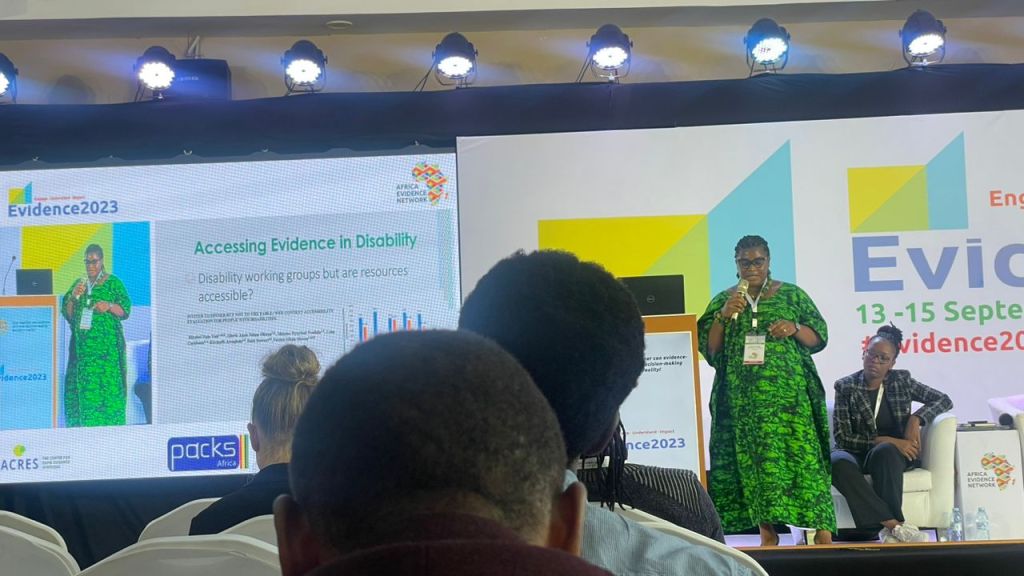
Building on Sibanda’s keynote, I presented a keynote on Valuing Evidence in EIDM Differently: Equity, Inclusion, and Trust. Chaired by Sibanda, the session brought together panellists from South Africa, Kenya, and Cameroon to explore how these principles must inform every stage of evidence-informed decision-making.
From eBASE Africa, I shared our experience with the Wakka project in Cameroon. This initiative was co-developed with persons with disabilities (PWDs) who prioritised the outcomes most meaningful to them. We leveraged existing community structures, such as community health workers, to bring research into households and used “Njangi”, a modified local savings model, to incentivise families to engage with evidence-based recommendations. Families who actively applied recommendations for their children with disabilities, reaching a score of 65 or more, were rewarded with seed funding to start income-generating activities. Proceeds were then managed through the Joseph’s Coat of Many Colours (JCC) model, ensuring that while children with disabilities benefited, their siblings and families were not neglected.
This approach embodied the global call of “nothing for us without us”. By building with people with disabilities, rather than for them, we redefined what equitable and inclusive decision-making could look like at the household level. The models of Njangi and JCC especially caught the audience’s attention, sparking curiosity about how such culturally grounded practices might be adapted even in scientific conference like #Evidence2023.
One moment stood out vividly: a colleague from Zimbabwe applauded the ideas but also posed a powerful challenge -“Now that we have developed these impressive tools and frameworks, we must ask: where are people with disabilities at the dinner table when these discussions happen?” Her words echoed the very metaphor I had used in my reflections on equity, invited to dinner but not to the table. I was both happy and humbled, happy that my lens was resonating with others, and humbled that this dialogue was sparking the collective self-examination our community needs.
The online Q&A reinforced this connection, with participants extending Sibanda’s reflections on decoloniality into practical questions about equity and inclusion. What emerged was clear: valuing evidence differently means not only developing new tools, but rethinking the systems and assumptions that shape how evidence is generated, communicated, and acted upon.
Relationships Matter: Lessons from the Panel
Another session that stayed with me was a panel on relationships where Marie Gaarder reflected on her own learning journey. She admitted that she once believed evidence spoke for itself that when people heard it, they would naturally act to make a change. Over time, however, she realized that the message matters, the delivery matters, and incentives matter.
For me, this was not a new discovery. Through the Wakka project and our Tori Dey approach, we had already seen how much the way evidence is communicated shapes whether communities can act on it. But hearing Marie share how her perspective shifted over time was affirming. It was a reminder that even seasoned evidence practitioners are continuously rethinking and adapting their practice.
Her reflection added meaning to my own work. In Cameroon, we bring evidence into households in formats families can understand, using trusted community health workers, and incentivising participation through Njangi. In our Tori Dey storytelling method, which also serves as an evaluation method, we listen with humility, not to interrogate or lecture, but to guide and accompany. Hearing Marie’s journey underscored for me that evidence is never neutral; relationships, trust, and care are always at the heart of its use.
Storytelling as Method: Tori Dey on the Global Stage
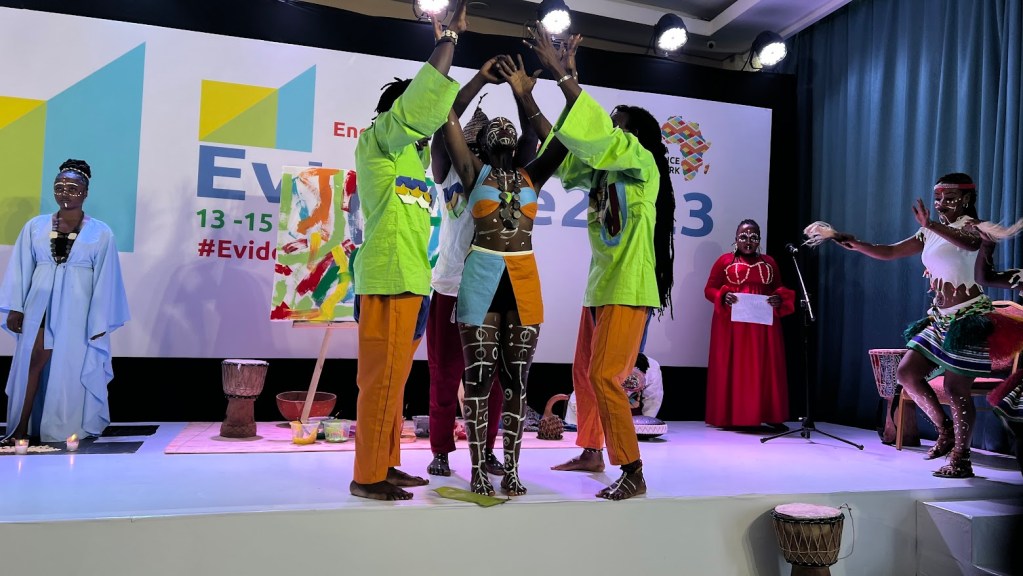
One of my proudest moment for me was when eBASE Africa opened the conference using Tori Dey. For the first time, a scientific conference began with storytelling, and the response was electric. Participants leaned in, not just listening but connecting to history, culture, and evidence in a language that felt deeply African.
This was, in many ways, a direct response to Sibanda’s challenge: if we are missing people, if we are privileging only written and statistical forms of evidence, then Tori Dey is one answer. Storytelling takes evidence back to communities, bridging the gap between non-literate citizens and the scientific world. It demonstrates that indigenous methods are not peripheral but central to rethinking how evidence is valued and used.
Since then, we have gone on to open the Transforming Evidence Network (TEN) Conference in Cape Town in 2024, the Cochrane Africa Indaba in Nairobi in 2025, and even shared this capacity with storytellers in Khayelitsha, who went on to deliver a powerful opening at the ESIC Consensus in Cape Town in June 2025. Each time, Tori Dey has affirmed that storytelling is not just performance, but a system-level tool for re-centering African voices in global knowledge production.
Proverbs That Guide My Leadership
Some of the wisdom from Evidence 2023 still guides me today. I often return to the African proverbs re-echoed by Rhona Mijumbi during the event:
– “A single bracelet does not jingle” — reminding me that collaboration and teamwork are essential.
– “A person’s wealth is not in the bank but in relationships” — which has never been more meaningful to me as an inclusive leader.
– “A single stick can smoke but not burn” — underscoring the importance of collective strength.
These sayings have become anchors in my inclusive leadership at eBASE Africa. They remind me that the work of equity and inclusion is not carried by individuals alone but by communities who lean on and uplift one another.
Looking Ahead: Evidence 2025 in Benin
Evidence 2023 was a turning point rich with inspiration, collaboration, and cultural exchange. As we now look ahead to Evidence 2025 in Benin, a French-speaking country, I see equity reflected even in the choice of host. Language is often an overlooked barrier in evidence use, with English dominating most publications and platforms. Hosting in Benin is a timely reminder that inclusivity requires us to engage people in their language and ensure that evidence does not remain locked in inaccessible formats.
I look forward to a more equitable evidence ecosystem where people with disabilities share their own stories standing at the table and not just spoken for. I also look forward to evidence being communicated in French and other local languages, truly reflecting ubuntu. Because truly, a single bracelet does not jingle.
About the author: Nain Mirabel Yuh is a seasoned programme manager for Gender Equity and Inclusion at eBASE Africa, with a strong background in research implementation and innovation. She leverages best practices to improve the livelihoods of underserved populations, particularly people with disabilities. With expertise in qualitative and quantitative research, Yuh develops innovative tools and solutions to drive positive change. Her extensive experience spans research design, data collection, project implementation, and presentation. A collaborative team player, Yuh has worked across various departments and projects, fostering a spirit of partnership and teamwork. She is driven by the conviction that building an inclusive Africa, where no one is left behind, is a collective responsibility that requires dedicated effort and commitment, especially for people with disabilities.
Acknowledgements: The author(s) is solely responsible for the content of this article, including all errors or omissions; acknowledgements do not imply endorsement of the content. The author is grateful to Charity Chisoro for her guidance in preparing and finalising this article, as well as her editorial support.
Disclaimer: The views expressed in published blog posts, as well as any errors or omissions, are the sole responsibility of the author/s and do not represent the views of the Africa Evidence Network, its secretariat, advisory or reference groups, or its funders; nor does it imply endorsement by the afore-mentioned parties.
Suggested citation: Yuh NM (2025) My First In-Person Evidence Event: Reflections from Evidence 2023. Blog posting on 22 September 2025. Available at: https://africaevidencenetwork.org/my-first-in-person-evidence-event-reflections-from-evidence-2023/2025/09/22/