
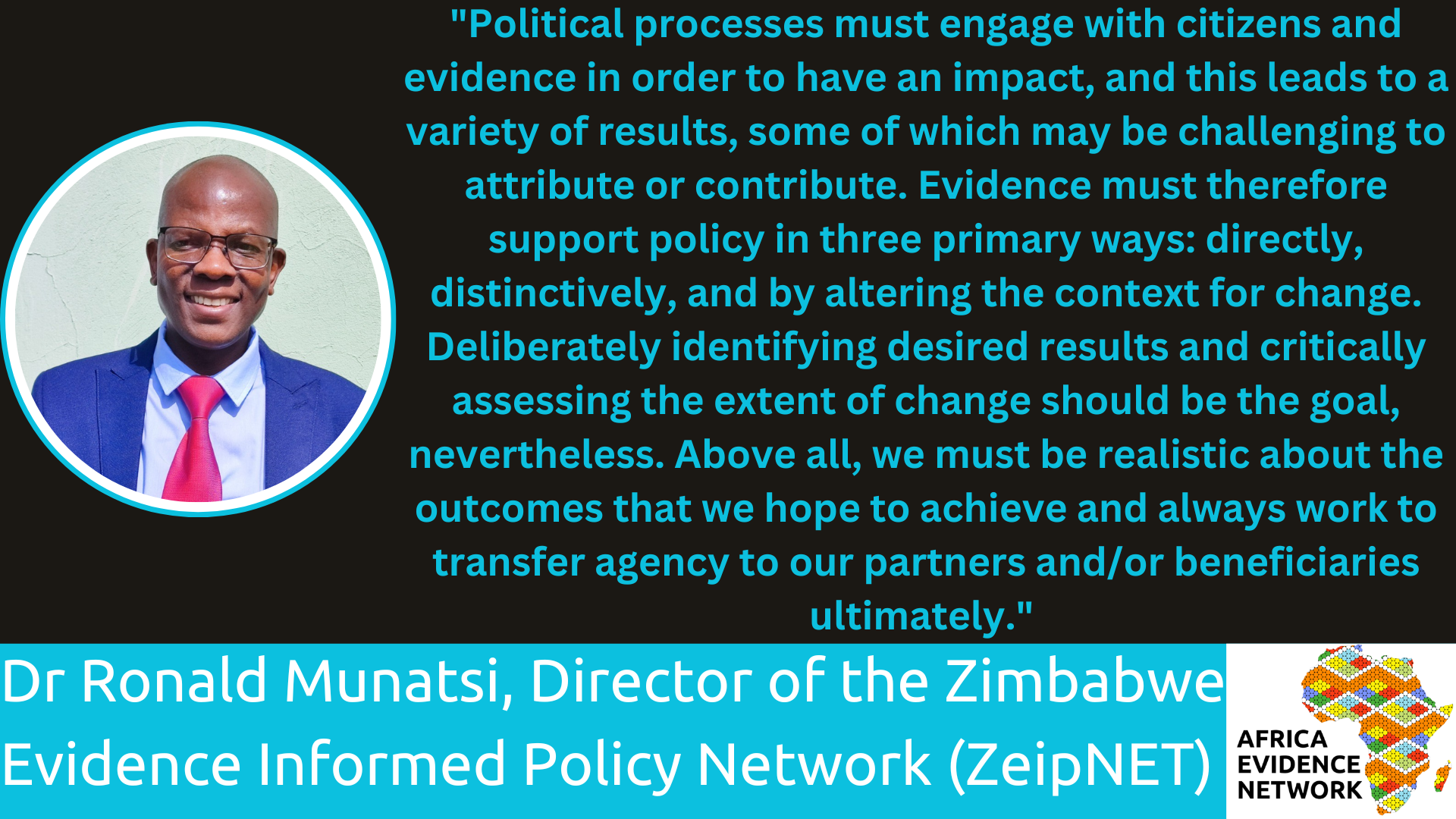
I had the privilege of participating in a webinar hosted by the British Academy on September 17, 2025, to help its evidence-informed decision-making (EIDM) programme grantees understand what policy impact in research-to-policy interventions means. Christine Kelly and Louise Shaxson were the presenters. The conversations were deep and enlightening. Issues with policy impact include overstating or understating impact and finding a balance between contribution and attribution, particularly when other actors are working on the same or comparable outcomes. In some cases, some people might not even be aware that they have had an impact worth reporting. The process of transforming policy practices is not linear because of the varying political and economic contexts, the different forms of evidence, and the policy actors and influencers involved. Numerous domains and pathways to policy change exist. Rather than direct causality, contributions to change require realistic expectations for attribution. Political processes must engage with citizens and evidence in order to have an impact, and this leads to a variety of results, some of which may be challenging to attribute or contribute.
Forms of policy impact
Although policy impact might vary greatly depending on the context, it can be classified mainly into four categories. Conceptual outcomes refer to changing the way policymakers think about and comprehend policy issues. For example, a new evidence-informed understanding of a societal issue may result in an innovative way of framing the issue as a whole. Attitude/behavioural outcomes include evidence-driven changes in policymakers’ attitudes and behaviours. This includes shifts in how policymakers view the importance of evidence, how they use it more frequently when discussing policies, or how they make decisions themselves. Results where evidence influences the methods or strategies utilised to formulate policy are referred to as procedural outcomes. For instance, evidence can enhance the creation, debate, and implementation of policies. The use of procedural instruments can alter how the government operates internally. This could mean establishing formal advisory groups, creating new organisations, or modifying laws pertaining to information access. Lastly, content outcomes demonstrate instances where the actual substance or content of new policies or initiatives is directly informed by evidence. This is the most direct kind of influence, where evidence is incorporated into specific legislation, policies, or programme designs to guide actions and accomplish desired results.
Outcome mapping for policy impact
Louise used a three-level outcome mapping approach developed by the International Development Research Centre (IDRC) to explain policy impact: “Expect to see outcomes” refer to early anticipated changes; if these are not observed, something is amiss. For example, you start getting demands from policymakers for ongoing involvement, your research is tabled, or your collaborators are requested to present. Even a significant adverse reaction to some of your suggestions is an impact “Like to see outcomes” refer to the intermediate changes, such as being included in steering groups or getting an introduction from a policymaker in one of your reports. The “love to see outcomes” refer to instrumental transformations that may take longer to manifest and include significant behavioural changes and tangible programmes—for example, incorporating suggestions into policy goals or a government organisation collaborating with other non-governmental actors on concrete projects. This model places a strong emphasis on direct, noticeable contributions and contextual changes for change.
No linear pathway to policy impact, but we strive to transfer agency
Evidence must therefore support policy in three primary ways: directly, distinctively, and by altering the context for change. These methods reflect a range of influence, from the direct, practical application of research results to a more strategic, nuanced, and long-term role. An immediate application of evidence to the development, modification, or execution of specific policies or programs is known as a direct or instrumental contribution. There is an obvious and traceable connection between the evidence and the policy conclusion, which frequently entails specific suggestions and evidence-driven choices. Evidence that gradually shapes policymakers’ underlying beliefs and knowledge rather than prescribing a specific course of action is a separate, or conceptual contribution. Even while it doesn’t result in a drastic change right away, this contribution helps reframe a problem and affect the intellectual landscape of a policy area. Using evidence to transform the entire political and social landscape in which policy is made is known as “changing the context for change.” It entails the purposeful use of evidence to rebalance power dynamics, empower certain players, and open up new political avenues for policy reform. This is the most long-term and strategic form of influence. Consequently, given political-economic complexities, there is no clear pathway to policy influence. Deliberately identifying desired results and critically assessing the extent of change should be the goal, nevertheless. Above all, we must be realistic about the outcomes that we hope to achieve and always work to transfer agency to our partners and/or beneficiaries ultimately.
About the author: Dr Ronald Munatsi is the Director of the Zimbabwe Evidence Informed Policy Network (ZeipNET). ZeipNET works to interface evidence and policy through evidence synthesis initiatives, including institutional capacity building focusing on the interface between research and policy with an emphasis on strengthening capacities across individual, institutional and systemic levels.
Acknowledgements: The author(s) is solely responsible for the content of this article, including all errors or omissions; acknowledgements do not imply endorsement of the content. The author is grateful to Charity Chisoro for her guidance in preparing and finalising this article, as well as her editorial support.
Disclaimer: The views expressed in published blog posts, as well as any errors or omissions, are the sole responsibility of the author/s and do not represent the views of the Africa Evidence Network, its secretariat, advisory or reference groups, or its funders; nor does it imply endorsement by the afore-mentioned parties.
Suggested citation: Munatsi R (2025) Policy impact in evidence-to-policy interventions: Be realistic about your envisaged outcomes and strive to hand over agency. Blog posting on 19 September 2025. Available at: https://africaevidencenetwork.org/policy-impact-in-evidence-to-policy-interventions-be-realistic-about-your-envisaged-outcomes-and-strive-to-hand-over-agency/2025/09/19/