Effective Basic Services (eBASE) Africa, is a multinational collaborativee organisation with headquarters in Bamenda, Cameroon. eBASE Africa is active in implementing charity and development projects targeting women, children, people living with disability and indigenous populations. We conduct research for basic services, including Health, Education, WaSH, Local Governance, Climate Resilience and Arts. We are active across the evidence ecosystem – generation, synthesis, translation and implementation.
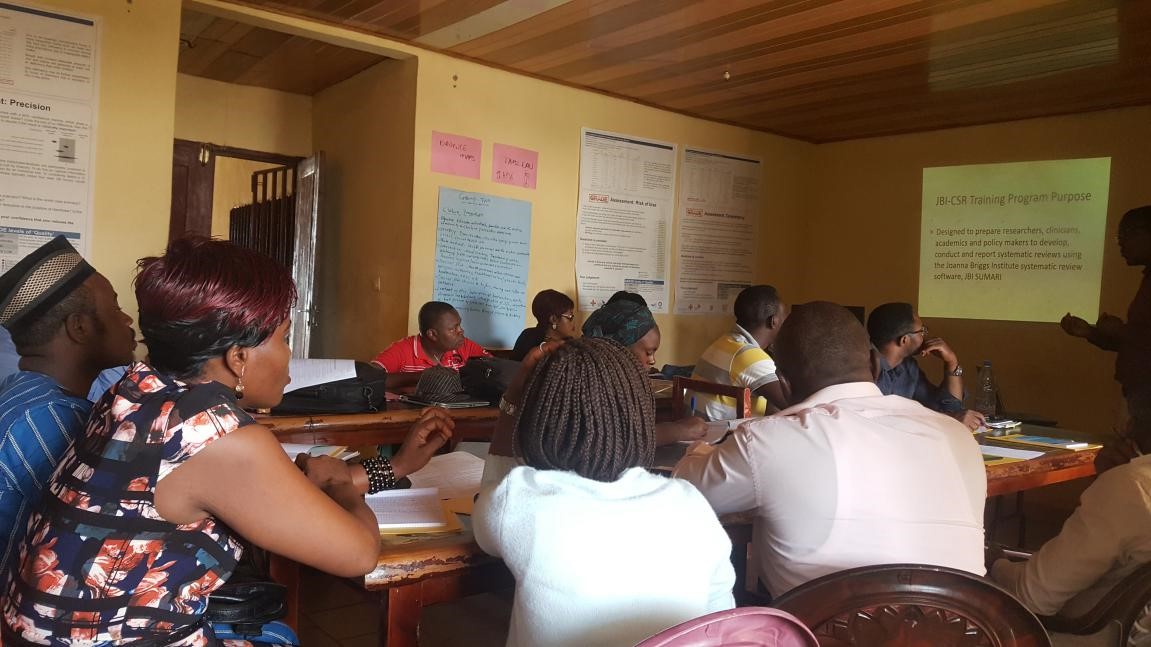
eBASE, Cameroon just completed its second batch of JBI-Comprehensive Systematic Review Training (JBI-CSRT) . So far, eBASE in two (02) training sessions has trained 18 secondary school teachers; 06 university lecturers; 10 clinicians; 02 district medical officers; 04 pedagogic inspectors; 05 civil society activists and 03 municipal councilors. This training aimed at enabling policy makers and practitioners identify and use relevant evidence in decision making within their spheres of influence. This is huge as these practitioners and policy makers serve an average of 243,262 secondary school students; 45,000 primary school children; 1,000 university students; 36000+ health care consumers; with 40% urban dwellers 60% rural dwellers targeted.
- Dr.Patrick Mbah Okwen, introducing Trainees to the JBI-CSRT Program
Trainees intended to use their refined review questions to search, grade and implement evidence in their fields of influence. After developing their pedagogy or clinical questions, we located each question on the JBI Evidence Wheel. For participants located on evidence synthesis, that is, where a systematic review is already available, we conduct an evidence translation process. If their question is already answered within an evidence portal e.g. guidelines, clinical or pedagogue decision support systems like EEF toolkit, we proceed to plan an evidence implementation project e.g. pedagogy audits and feedback. In essence all questions located after evidence synthesis may not require de-novo systematic review but may require contextualization. All questions located before evidence synthesis will require systematic reviews or primary studies.
So innovative! Is the fact that some policymakers used social media platforms like twitter to sample stakeholders’ opinion on most important educational outcomes to incorporate in their review questions. An Example of questions posed on Twitter included: ‘Have been wondering what interventions could help sustain learner’s interest in languages’ by @tildaandie .
The profile of our questions ranged from clinical practices, pedagogical policies and practices, environmental protection, local governance to financial inclusion. This approach of bringing diverse policy makers and practitioners together in a training session can be challenging to model but beautiful! The challenge here resides in tailoring training modules to incorporate diverse backgrounds. Nevertheless, the beauty of this ‘mixing’ lies in the fact that, though researches could be done in a solo, solutions to problems are multidisciplinary in nature. Therefore bringing together policy makers and practitioners from a cross section of the economy permits decision makers to formulate holistic questions. A good example is the case of mass distribution of mosquito bed nets in Cameroon to households for the fight against malaria. This good initiative has not yielded the intended impact given that it was a purely health solution to a population that is more concerned with dealing with hunger (agricultural and economic) than malaria;as seen in the use of mosquito bed nets in vegetable farming to keep away birds and as fishing nets. It could therefore be cheaper and more effective for policymakers to use holistic review questions to search, grade and implement evidence in decision making.
Trainers and Trainee Family Picture at eBASE Africa, Cameroon
Ndi Euphrasia Ebai-Atuh (eBASE Africa) ; Patrick Mbah Okwen (eBASE Africa)
Email: euphrasia@ebaseafrica.org;okwen@ebaseafrica.org
Website: www.ebaseafrica.org;
Twitter: @ebase_africa
Tel: +237 677319374 / +237 674486612