
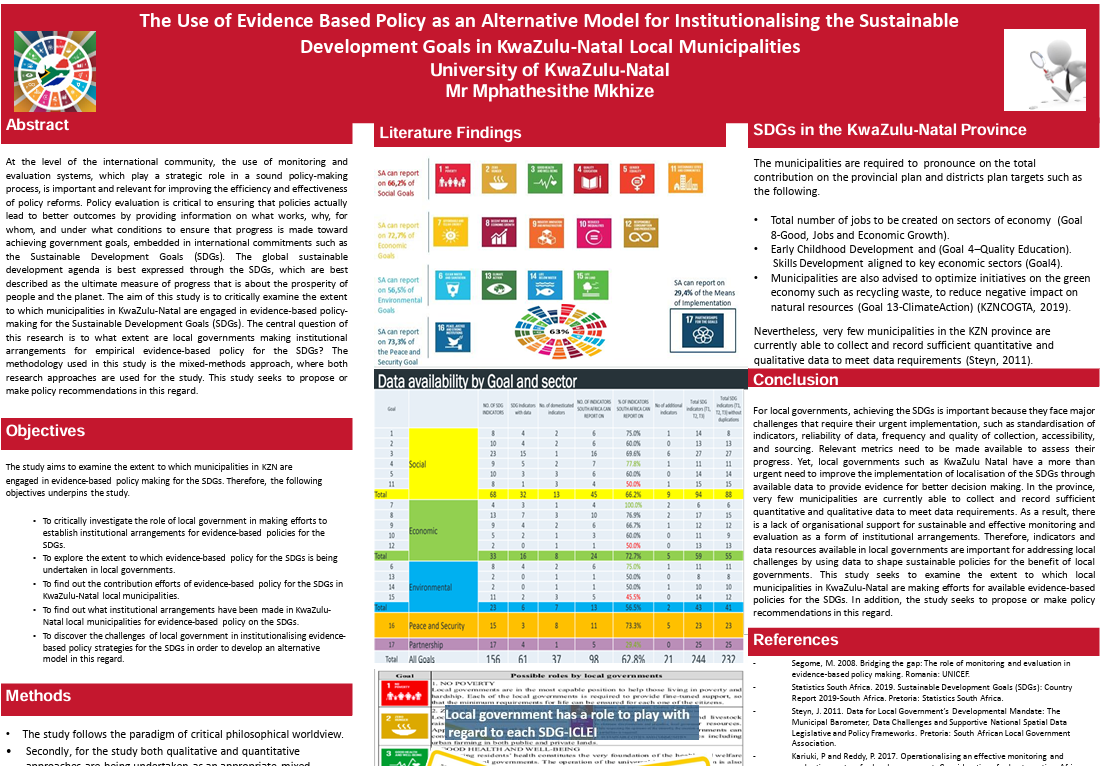
At the level of the international community, the use of monitoring and evaluation systems, which play a strategic role in a sound policy-making process, is important and relevant for improving the efficiency and effectiveness of policy reforms. Policy evaluation is critical to ensuring that policies actually lead to better outcomes by providing information on what works, why, for whom, and under what conditions to ensure that progress is made toward achieving government goals, embedded in international commitments such as the Sustainable Development Goals (SDGs). The global sustainable development agenda is best expressed through the SDGs, which are best described as the ultimate measure of progress that is about the prosperity of people and the planet. The aim of this study is to critically examine the extent to which municipalities in KwaZulu-Natal are engaged in evidence-based policy-making for the Sustainable Development Goals (SDGs). The central question of this research is to what extent are local governments making institutional arrangements for empirical evidence-based policy for the SDGs? The methodology used in this study is the mixed-methods approach, where both research approaches are used for the study. This study seeks to propose or make policy recommendations in this regard.