Globally, there is increasing interest and excitement around the need for evidence to inform the policymaking process. This interest is informed by the fact that the utilisation of research evidence in policymaking processes enhances the effectiveness, efficiency and legitimacy of decision-making. In Africa, a key aspect of this interest is the recognition that evidence is instrumental in identifying the most effective interventions for optimal development outcomes. Despite the ever-increasing appetite for evidence use in the policymaking process, evidence uptake remains low due to the unpredictable environment in which policymakers have limited control. The nature of the policymaking process is not only unpredictable but also complex, messy, and crowded with many actors competing for influence on the policy outcome. In this complex terrain, policymakers struggle to settle on the compelling evidence that offers the best solution to the societal problem.
As a major player in the evidence ecosystem in Africa, the Partnership for African Social and Governance Research (PASGR) has innovated a model since 2015 for bridging the gap between evidence generation and the policymaking process, known as Utafiti Sera – a Swahili phrase meaning Research Policy. This model fosters a collaborative knowledge production system in which researchers, policymakers, and community stakeholders co-create relevant evidence tailored to the contextual public policy challenges. Central to the model’s effectiveness is the recognition of ingrained policy cultures, which often hinder the uptake of evidence in decision-making processes. The model is conceptualised around ‘Utafiti Sera Houses’ (structures for knowledge production), which facilitate co-creation with dynamic communities of practice, promoting inclusivity through interdisciplinary engagement to enable civil society, academia, think tanks, and government actors to co-identify and address local problems through empirical research. This multi-stakeholder engagement model not only addresses the complexity of policymaking but also cultivates a nuanced understanding of local governance issues across several African nations.
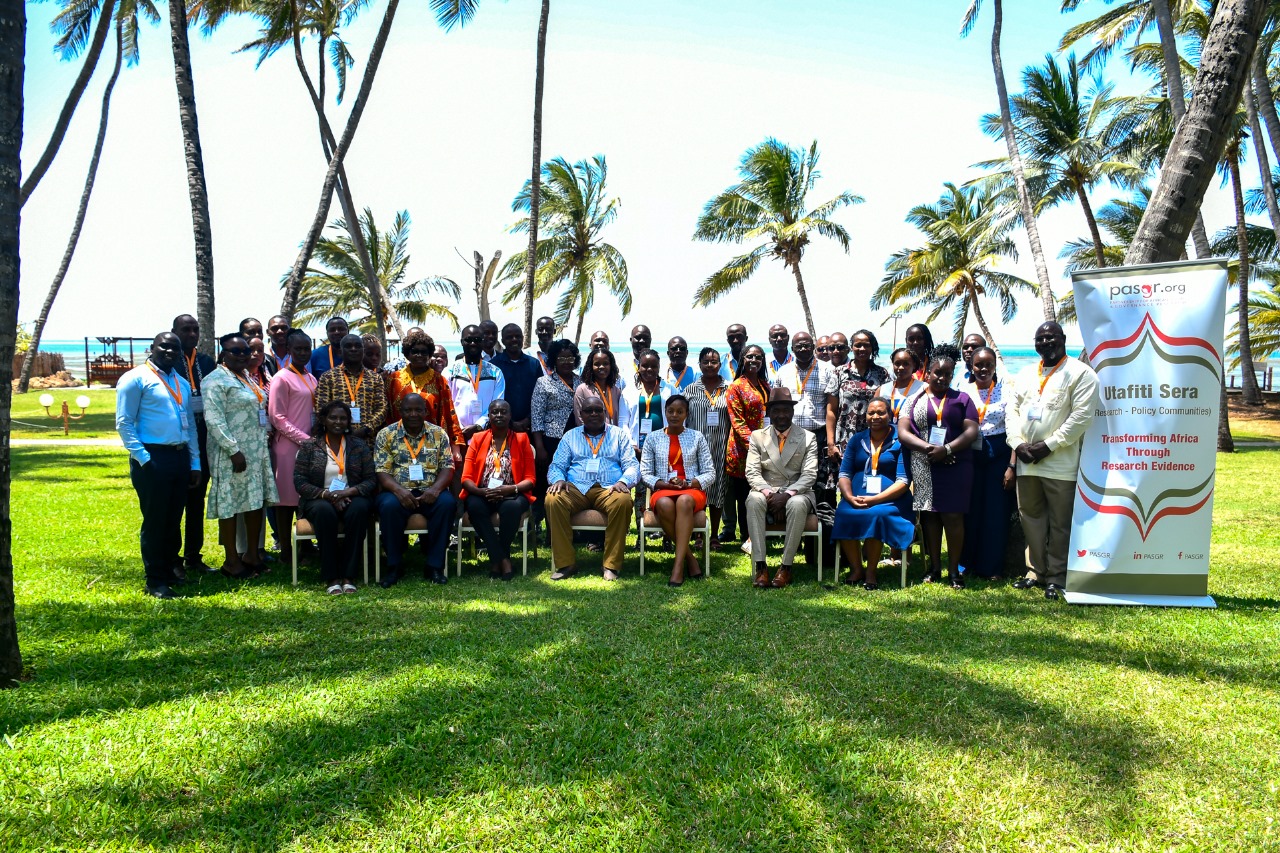
Against this backdrop, PASGR organised a Utafiti Sera Inter-House Learning and Sharing Convening from September 9 – 11, 2025, in Mombasa, Kenya, for the Utafiti Sera Houses to collaborate, share experiences and lessons learnt on the best strategies for policy uptake. For the three days, members from the Utafiti Sera Houses; Urban Governance Houses in Kenya and Rwanda, Universal Health Coverage House in Zambia, Youth Employment Creation House in Kenya, the Policy Cultures Study research team (from Kenya, Rwanda, and Nigeria), representative from academia, civil society, government and think tanks turned the conversations during the Utafiti Sera Inter-House convening, into a co-learning space exchanging successes, reflecting on challenges, and reimagining strategies for evidence uptake in African policymaking.
What qualifies as evidence?
Evidence is often understood as data, research findings, or assessments that policymakers interpret as information subjected to scientific rigour to ensure its credibility in informing policy development. Yet, policymaking is rarely a purely technical process but inherently political and crowded by multiple actors with competing interests. This duality explains why some evidence shapes national programmes while others, equally rigorous, remain underutilised. As one key stakeholder noted, ‘not all executive orders are evidence-informed and even when policies begin with evidence, sustained uptake is not always guaranteed’. Zambia’s National Health Insurance Fund illustrates this. While it was founded on evidence showing high out-of-pocket health costs and limited private insurance, subsequent evidence on its operational challenges has been sidelined due to political inertia, leaving the fund on shaky ground.
Where Evidence Has Moved the Needle
Despite such realities, the convening spotlighted examples where evidence did break through and shape policy and practice;
- Kenya: Evidence from the Urban Governance House has informed the uptake of social safeguards in infrastructure development promises.
- Rwanda: Evidence from the Urban Governance House in Rwanda has informed prioritisation of social issues, mainly on waste management, in the City of Kigali and other selected secondary cities.
- Kenya: The Youth Employment Creation House has established living online labs where young women and men test agribusiness ventures, tapping into agricultural value chains.
- Zambia: Evidence from the Universal Health Coverage House has strengthened pathways toward Universal Health Coverage, supported by a House champion inside the government who pushes for uptake.
These examples demonstrate that success in evidence uptake is achievable when evidence is co-created, communicated effectively, and aligned with the policy windows and political realities of a country’s governance structure.
The Weight of Unused Knowledge
Still, a persistent problem hung over discussions: the wealth of unused research findings and publications in universities. Countless dissertations and publications gather dust instead of fuelling urgent policy debates. Agriculture offers a clear example; fertiliser subsidies have sometimes been poorly designed, not because evidence was lacking, but because it was ignored in favour of expediency. The challenge is cultural as much as technical, nurturing an environment where evidence-informed decision-making (EIDM) is the default, not the exception, across sectors, ensuring that policies remain relevant and effective.
Policy Culture: The Way of Doing Things
One of the most intriguing conversations centred on the policy cultures study, which examines how norms, histories, and everyday practices influence whether evidence is taken seriously. The study, commissioned in Kenya, Nigeria, and Rwanda, reminds us that evidence is never consumed in a vacuum. Policymakers don’t just read a report; they interpret it through their own political realities, institutional habits, and even the way evidence is packaged. Understanding policy culture means looking back at how past policies were developed, what kinds of evidence mattered and to whom, and how they were communicated. It also means looking forward, i.e., how to present research in ways that speak the language of those who hold power to act. For Utafiti Sera Houses and policymakers and policy influencers, this lens offers practical guidance on how to move beyond producing evidence for the shelf and toward embedding it in real decisions.
A Call for Continuous Learning
What stood out most was the need for continuous capacity strengthening of the Utafiti Sera Houses. Each house must ground itself in its unique context, internalise lessons, and build the agility to navigate complex policy environments. Opportunities to advance evidence uptake away from the conventional methods the houses have been relying on exist including using evidence generated to participate in the; international reporting mechanisms, the Public Finance Management processes to ensure that evidence generated are resourced, engagements with development banks whose internal policies have significant impacts on national policies and practices and participating in invited and invented spaces to disseminate the evidence houses generated. What became clear is that evidence uptake is anything but not linear. It is political, relational, and deeply cultural. But with communities of practice like Utafiti Sera Houses, Africa is cultivating a movement where evidence reflects people’s lived realities and actively drives inclusive policies and programmes.
About the authors:
Jim Kaketch is a resourceful professional, self-driven, and passionate about institutionalising evidence use in the policymaking process in Africa. Currently, he is a Senior Programme Officer in charge of the Partnership for African Social and Governance Research (PASGR’)s Utafiti Sera project (Urban Governance, Kenya and Rwanda; Youth Employment Creation, Kenya; Universal Health Coverage, Zambia); Policy Cultures Study in Nigeria, Kenya and Rwanda; and Food Systems Transformation project, Kenya, to enhance evidence-informed policymaking in governance process in Africa. Kaketch also coordinate the African Youth Pathways to Resilience and Systems Change (AYPReS) project in 10 African countries. He holds an MSc in Public Policy & Administration, London School of Economics and Political Science, UK (Chevening Scholarship) and an MA in Political Science & Public Administration, University of Nairobi, Kenya (UoN Merit Scholarship). Kaketch has over 10 years of progressive experience gained through working on multi-year regional and country-level programmes on diverse thematic areas.

Irene Kinoti is a Researcher at Pamoja Trust and an expert in land and housing rights, environmental justice, and inclusive urban and rural development. A trained Urban and Regional Planner, she has over six years of experience applying action research and community-centred approaches across diverse contexts, particularly in informal settlements. Her work focuses on generating evidence that is grounded in reality to inform and influence policy and practice. At Pamoja Trust, Irene plays a key role in synthesising evidence emerging from the organisation’s work, including contributions to the Utafiti Sera Urban Governance Platform. She is deeply committed to strengthening community agency, promoting equitable development, and advancing rights-based approaches within planning and governance processes.

Sally Miruri is a Lawyer and Human Rights Advocate with over 8 years of experience specialising in land and housing rights, international law, responsible business conduct and urban governance. She holds a Bachelor of Laws degree from the University of Nairobi and an Advanced Diploma in Law from the Kenya School of Law. She is currently pursuing an LL.M. at the University of East London. Sally is a programme officer at Pamoja Trust (PT) and facilitates the Utafiti Sera House on Urban Governance and City Transformation, hosted by PT. She is an expert in land governance and urban development, with a strong focus on access to remedy and community-led solutions. Her work involves close collaboration with grassroots groups to document their innovations and insights that are strategically used to shape and influence policy. Beyond policy, she actively supports communities in tracking public budgets, empowering them to participate meaningfully in urban governance and development decision-making.

Acknowledgements: The authors are solely responsible for the content of this article, including all errors or omissions; acknowledgements do not imply endorsement of the content. The authors are grateful to Charity Chisoro for her guidance in preparing and finalising this article, as well as her editorial support.
Disclaimer: The views expressed in published blog posts, as well as any errors or omissions, are the sole responsibility of the author/s and do not represent the views of the Africa Evidence Network, its secretariat, advisory or reference groups, or its funders; nor does it imply endorsement by the afore-mentioned parties.
Suggested citation: Kaketch J, Kinoti I & Miruri S (2025) Utafiti Sera Communities of Practice Enhancing Evidence Uptake into Inclusive Policy and Programme Actions in Africa. Blog posting on 20 November 2025. Available at: https://africaevidencenetwork.org/utafiti-sera-communities-of-practice-enhancing-evidence-uptake-into-inclusive-policy-and-programme-actions-in-africa/2025/11/20/