
The dream of a digitally inclusive Tanzania is not just a personal ambition; it is a necessity for our nation’s survival in the modern global economy. For years, I have been guided by a singular, haunting question: Why are so many of our brilliant Tanzanian graduates, full of potential and energy, struggling to find meaningful work? When I set out to find the answer, the data was sobering. My research revealed that 66% of graduates reported a significant lack of the soft, practical digital skills required by the modern labour market. This wasn’t just a gap; it was a chasm.
This evidence became the blueprint for Tanzania Enlightenment Development Innovations (TEDI). We realised that building schools wasn’t enough; we had to bridge the specific divide between theoretical education and real-world opportunity. Today, that mission has evolved into a nationwide movement, fueled by strategic partnerships with local governments and international allies who share our vision of an evidence-informed future for Tanzania’s youth.
The National Context: Aligning with Tanzania’s Digital Education Strategy
Our work does not exist in a vacuum. The Government of Tanzania, through the Ministry of Education, Science, and Technology, has laid a visionary foundation with the National Digital Education Strategy. This strategy recognises that ICT is no longer an “extra-curricular” luxury but a core pillar of pedagogical excellence. The government’s commitment to integrating technology into the primary and secondary curriculum is a bold step toward transforming Tanzania into a knowledge-based economy.
However, the scale of this challenge is immense. While the government works to provide the policy framework and primary infrastructure, there is a critical need for “last-mile” implementation. This kind ensures a computer lab isn’t just a room full of dusty hardware but a living, breathing hub of innovation. This is where our initiative, the “One Computer Lab, One School” programme, finds its purpose. We serve as the bridge between national policy and classroom reality, ensuring that the government’s digital goals are met with functional, impactful, and sustainable solutions.
A Holistic Vision: The “One Computer Lab, One School” Programme
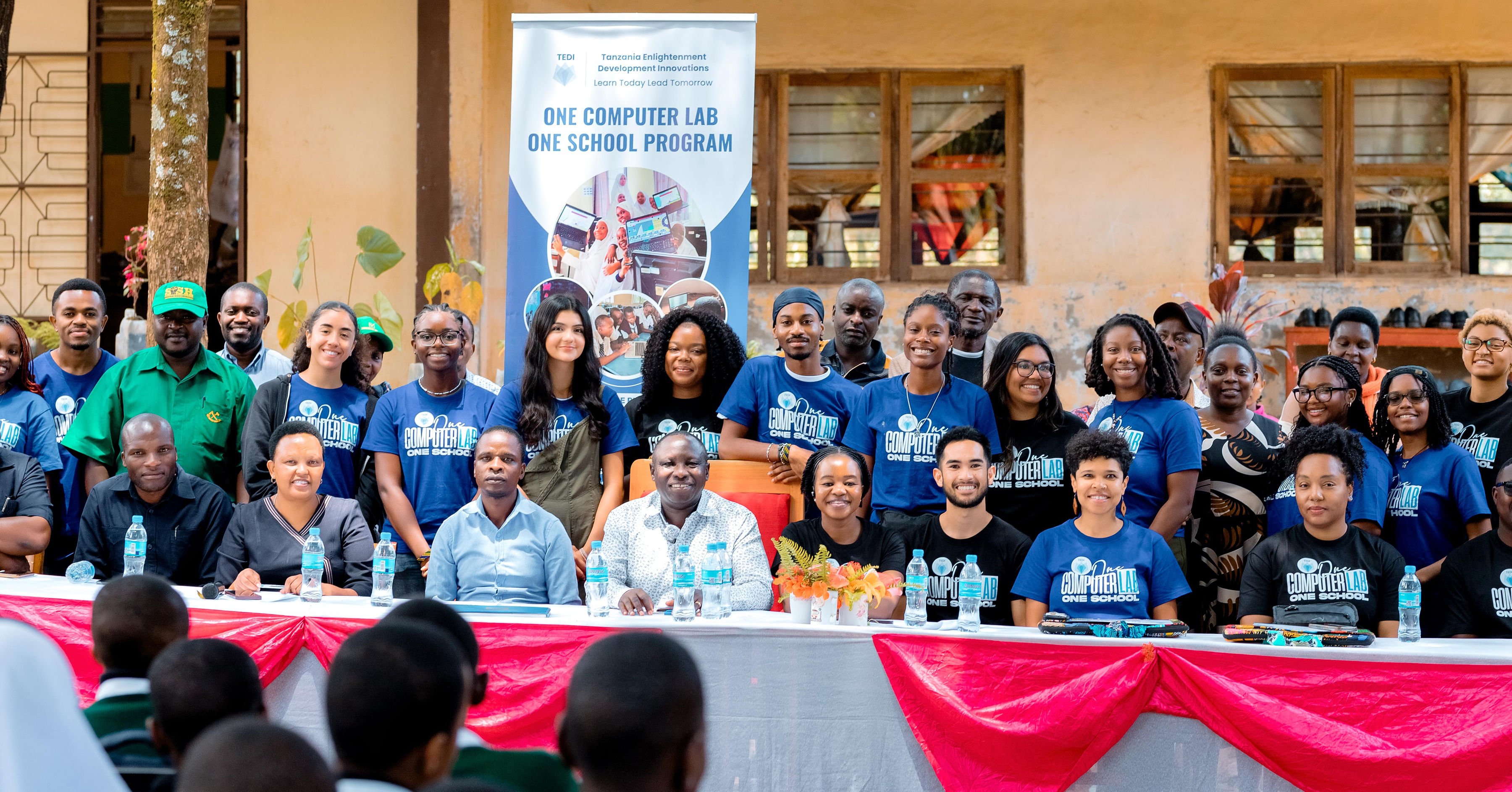
The “One Computer Lab, One School” programme is our flagship answer to the digital divide. Our approach is holistic, moving beyond mere hardware provision to encompass the entire learning ecosystem. For a digital revolution to take hold, four elements must align: Hardware, Content, Capacity, and Sustainability. Our monitoring and evaluation (M&E) framework ensures we stay honest about our progress. In our February 2025 assessment of four pilot sites, we were proud to see an 87% hardware functionality rate. More importantly, the human data told a story of hunger for knowledge: 65% of students were accessing these labs multiple times a week. These aren’t just statistics; they represent thousands of hours of Tanzanian youth learning to code, research, and create.
But evidence also tells us when we need to pivot. When our data showed that 54% of students identified poor internet as a major barrier, we didn’t wait for a fibre-optic miracle; we integrated the Rachel Server, an offline digital library that provides science, math, and coding content without requiring a direct internet connection. Similarly, when we saw that 44% of students struggled with complex topics like coding, we didn’t blame the learners; we launched the “Teach Tech” project to equip ICT teachers with the advanced pedagogical skills they need to lead.
The Power of Partnership: Global Support for Local Impact
No leader or organisation can do this alone. Our impact is multiplied by the incredible partners who stand beside us.
● Drexel Tech Serve: Through our partnership with Drexel Tech Serve, we have been able to tap into global technical expertise, ensuring that the digital tools we provide are cutting-edge and aligned with international standards. This collaboration helps us bring the best of global innovation to the local Tanzanian classroom.
● Give Power Foundation: Energy is the lifeblood of digital education. In many of the regions we serve, unreliable power is a constant threat to learning. Our partnership with the Give Power Foundation has been instrumental in providing sustainable energy solutions, ensuring that our “One Computer Lab, One School” sites stay powered even in the most remote areas.
These partnerships demonstrate that when international expertise meets local leadership, the results are transformative. We are not just receiving aid; we are building a collaborative engine for change.
Scaling with Certainty: The Kibaha District Success
The true test of our model lies in its scalability within the government framework. The power of evidence is most visible when local leaders use it to make bold decisions. In Kibaha District, the success of our pilot lab at Viziwaziwa Secondary School served as a “proof of concept” that the government could trust.
Based on the tangible impact seen in student engagement and digital literacy, District Commissioner Nickson Simon recently announced an ambitious plan to establish computer laboratories in all government secondary schools across the district. This is a landmark moment. By utilising AI applications for lesson planning and curriculum-aligned digital resources, Kibaha is now setting a national standard for how local government and NGOs can scale digital infrastructure together.
A Personal Call to Action
As I look toward the future, I am filled with a sense of urgency and hope. We are currently navigating a “success bottleneck”: our hardware is available, but the 2024 National Curriculum Reforms demand a shift toward more advanced classroom integration. We must “future-proof” our existing sites, moving beyond basic literacy to true pedagogical excellence.
To my fellow leaders, practitioners, and community members: data is not just for researchers sitting in offices; it is for the “users,” the practitioners who dare to let facts drive their decisions. Whether you are a teacher in a rural school, a government official in the Ministry, or a global partner, you have a role to play.
Together, we are doing more than just installing computers. We are dismantling poverty. We are empowering the next generation of Tanzanian innovators, thinkers, and leaders. We are building an evidence-informed future where every child, regardless of their background, has a fair shot at the digital age.
The revolution is here, and it is being built one lab, one school, and one student at a time.
About the author: Gloria Anderson is the Founder and Executive Director of Tanzania Enlightenment Development Innovations (TEDI), a non-governmental organisation dedicated to improving the quality of education in Tanzania by integrating practical skills into the educational system. Under her leadership, TEDI provides programmes such as entrepreneurship and employability skills training, as well as digital literacy initiatives. One of her notable projects, “One Computer Lab, One School,” aims to establish computer labs in under-resourced public schools, equipping students and teachers with essential computer skills, including e-learning and e-teaching through educational tools, e-libraries, and e-platforms.
TEDI was founded based on evidence from a research study conducted by Gloria on graduates’ perceptions of the contribution of university education to employability in Tanzania. The study revealed a significant gap between theoretical knowledge provided by the education system and the practical skills required in the job market and business environment, with 66% of graduates reporting a lack of soft skills. Gloria believes the key to Africa’s development is generating and utilising evidence to drive transformational impacts.
Acknowledgements: The author(s) is solely responsible for the content of this article, including all errors or omissions; acknowledgements do not imply endorsement of the content. The author is grateful to Charity Chisoro for her guidance in preparing and finalising this article, as well as her editorial support.
Disclaimer: The views expressed in published blog posts, as well as any errors or omissions, are the sole responsibility of the author/s and do not represent the views of the Africa Evidence Network, its secretariat, advisory or reference groups, or its funders; nor does it imply endorsement by the afore-mentioned parties.
Suggested citation: Anderson G (2026) Beyond Hardware: Scaling Digital Education through Local Government Collaboration in Tanzania. Blog posting on 20 March 2026. Available at: https://africaevidencenetwork.org/beyond-hardware-scaling-digital-education-through-local-government-collaboration-in-tanzania/2026/03/20/