
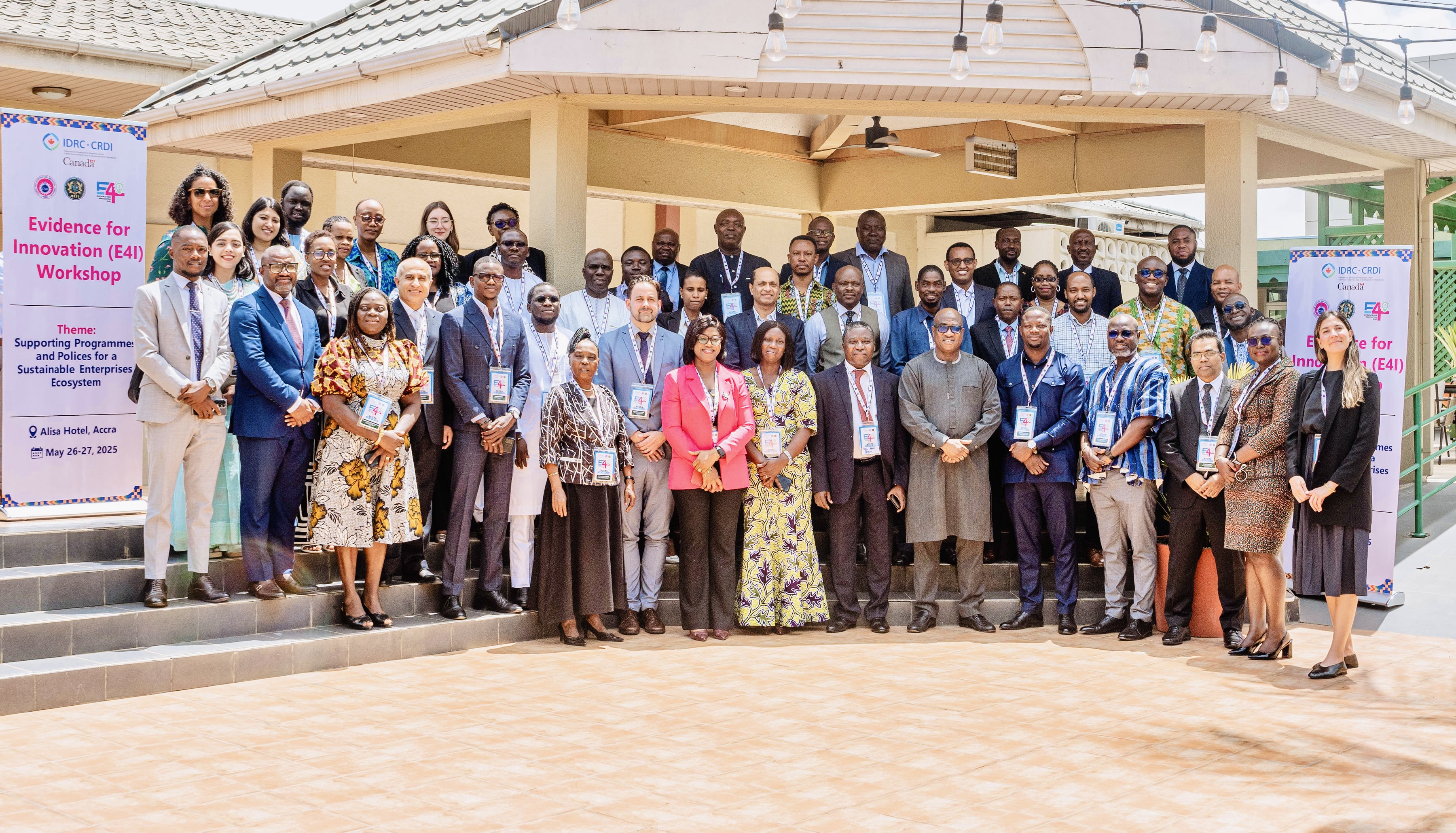
As the global development agenda increasingly focuses on innovation as a driver of transformation, the question remains: how can governments ensure that innovation support programmes are effective, inclusive, and responsive to national needs? This was the central theme explored at the recent Evidence for Innovation workshop, jointly hosted by the International Development Research Centre (IDRC) and the Science and Technology Policy Research Institute (CSIR-STEPRI) in Accra, Ghana. Held under IDRC’s Evidence for Innovation (E4I) Initiative between May 26-27, 2025, the workshop convened over 60 participants from Africa, Asia, and the Americas, including high-level policymakers, innovation agencies, researchers, and development partners. The E4I initiative seeks to generate new evidence on the performance and the distributional impacts of innovation support programmes for SMEs; promote collaboration between researchers and innovation agencies; and strengthen networks and capacity for analysis and implementation of innovation policies.
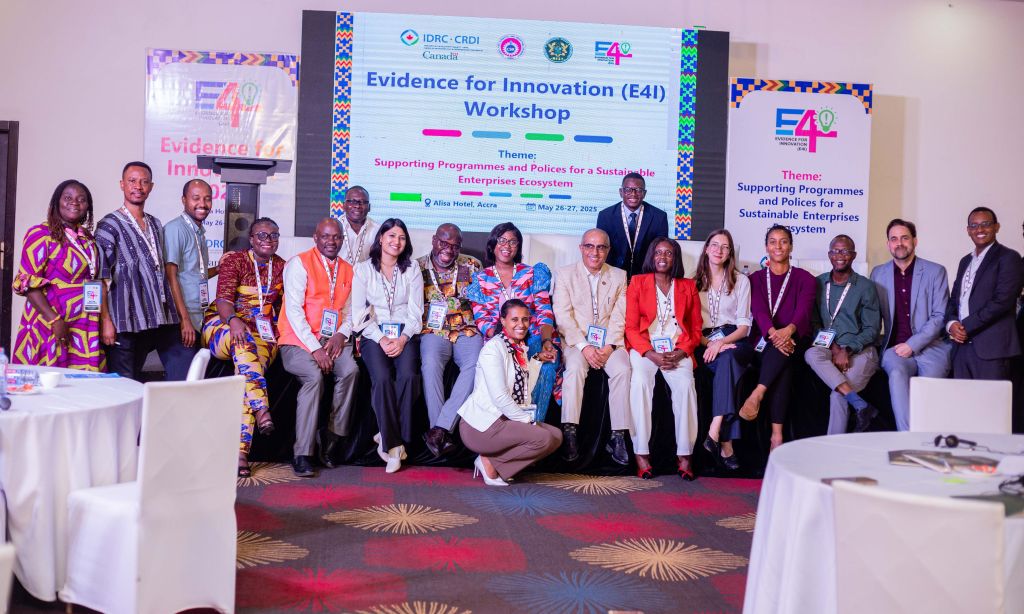
The initiative supports research and related activities on the performance and distributional impacts of SME support programmes or policies (e.g., on women-led enterprises, access to goods and services in underserved communities, and youth employment). A wide range of policies and services, referred to here as innovation support programmes, seek to create and develop SMEs. The performance of such programmes has been examined, but there is considerable scope to strengthen the evidence base in low-income countries, which is the geographic focus for this initiative.

Nine E4I projects from Ghana, Benin, Bangladesh, Tanzania, Zambia, Ethiopia, and Nepal were selected through a multi-stage process, beginning with the results of an open call in 2020. It was hence essential to convene the project teams from across Africa and Asia, providing avenues for knowledge sharing, collaboration, and building connections with innovation agencies and private sector actors. The discussions focused on how evidence generation and use, contextual understanding, and how cross-sector collaboration can improve the design and delivery of national innovation policies and support programmes.

Some of the highlights from the discussion include:
The need to move away from assumptions to evidence-informed actions
Participants agreed that innovation support must begin with a clear understanding of the problem, grounded in local evidence. Drawing on experiences from Ghana, Benin, Zambia, Nepal, and Ethiopia, country teams shared how policy-oriented research has helped identify the root causes of low innovation uptake, from financing gaps and regulatory burdens to capacity constraints and weak coordination. “Innovation cannot be imported wholesale,” one speaker emphasised. “It must be adapted to the political economy and institutional realities of each country.” This reflection was echoed in multiple sessions, highlighting the importance of locally-led diagnostics in informing technology policies and investment decisions.
Innovation happens at the intersections
One of the most powerful takeaways was the recognition that sectoral innovation is not enough. While innovation policies often focus on specific sectors such as agriculture or health, real impact emerges at the interfaces between sectors, where agriculture meets finance (agri-fintech), health meets technology (e-health), or education meets digital platforms (ed-tech). Participants from Ghana noted that despite agriculture’s centrality to the economy, its interlinkages with other sectors alone do not guarantee food security or job creation. Instead, innovation support must be cross-sectoral, digitally-enabled, and designed for systems change.
Balancing efficiency with inclusion
Another central theme was the tension between supporting “high-potential” innovators and ensuring equity in innovation ecosystems. While targeted support for scalable ventures is essential, participants warned against overlooking marginalised groups, particularly women, youth, informal sector actors, and rural entrepreneurs, who often face disproportionate barriers to access. Gender disparities were highlighted as a persistent concern in financing schemes. Women are frequently excluded due to collateral requirements, revenue thresholds, limited sectoral participation, and a lack of personal equity. Speakers emphasised the need for gender-responsive innovation programmes that actively remove these structural barriers and tailor support mechanisms to women-led enterprises.
Political will and competing priorities are imminent
In discussions on policy implementation, participants acknowledged that governments must make difficult choices between funding long-term innovation programmes and addressing immediate needs such as water, electricity, or health. These trade-offs become particularly sharp in election years, when public demands for basic services can take precedence. Nevertheless, a strong case was made for embedding innovation within broader development goals, emphasising that inclusive innovation is not a luxury; it is a strategic necessity for economic resilience and inclusive growth.
Evidence as the engine of reform
Across all countries’ experiences, it became clear that research and evidence generation are not auxiliary; they are foundational. Teams from Ghana, Benin, Zambia, and Nepal shared how two to three years of targeted, policy-relevant research under the E4I initiative led to tangible shifts in programme design. In Ghana, for example, this included redesigning the new entrepreneurship support programme to serve better women, young and rural entrepreneurs to boost employment outcomes. The reaffirmation that research is the skeleton that fuels policy reform, promoting good practice, shaping programme redesign, and ultimately contributing to more sustainable innovation systems was very clear.
Conclusion and Key Takeaways for Policy & Practice
The Evidence for Innovation convening reaffirmed a shared belief: inclusive, evidence-informed innovation policies are essential to solving development challenges in Africa and beyond. Whether supporting MSMEs, driving digital transitions, or addressing gender gaps, innovation systems work best when they are grounded in local realities, driven by data and research, and co-designed with the communities they serve. As innovation agencies look to the future, the sustainability of the E4I efforts should be recognised:
- embedding evidence-use into internal decision-making processes;
- strengthening internal capacity to adapt based on lessons learned; and
- ensuring financial and political backing to scale up successful pilots.
There is a strong consensus for the innovation ecosystem to be coordinated appropriately, with actors across government, academia, civil society, and the private sector working collaboratively to unlock systemic change. Ultimately, the impact of innovation support programmes hinges on the timely and appropriate use of credible, co-generated evidence.
As take-away messages for policy and practice, these are proposed:
- Before designing innovation programmes, generate and use local evidence.
- Design for intersections: agri‑digital, health‑tech, and education tech innovations offer the greatest impact.
- Balance scale with accessibility by including marginalised groups from the outset.
- Embed gender-centred design in finance, training, and programme eligibility criteria.
- Connect innovation with everyday public services through clear impact pathways.
- Institutionalise research within agencies to fuel continuous policy improvement.
- Embed evidence and learning into operational processes for long-term sustainability.
- Leverage regional knowledge networks to strengthen cross-country learning and co-creation.
About the author: Dr. Justina Adwoa Onumah is a Senior Research Scientist at the CSIR-Science and Technology Policy Research Institute (STEPRI) in Ghana. In 2023, she received the Africa Evidence Leadership Award (AELA) in the Evidence Producer category. Justina is a mentor for the Africa Evidence Youth League (AEYL). She holds a PhD in Development Studies from the University of Ghana with research interests in impact assessment, innovation systems, research-policy-industry linkages, science policy, rural development, food security, poverty/welfare issues, technology transfer, and the general field of economics of innovation and growth. She has authored publications in these fields and gained over ten years of rich research experience. Justina is an award-winning scholar with several awards and fellowships to her credit. In 2021, one of her PhD papers was adjudged the Best PhD Student Paper presented at the GLOBELICS conference held in Costa Rica. She is also a recipient of the 2021/2022 University of Ghana Vice Chancellor’s Prize for the Overall Best Graduating PhD student in Development Studies. Justina holds other certifications in Evidence and Policy from the European Commission Joint Research Centre and Science Diplomacy from the World Academy of Sciences. She has contributed to policy engagement and policy-making processes by generating synthesised evidence for policy uptake, a key mandate of her Institute.
Her work in the evidence space received recognition in 2016 when she led a team to win the Marketplace of Ideas competition during the EU-AU Evidence and Policy event held at the European Union Joint Research Centre in Italy. Justina is passionate about creating awareness of STEM and advocating for evidence use in policy-making through dialogues and other speaking engagements. Justina speaks on several issues, including Bridging Science and Policy, Science diplomacy, Research Commercialisation, Strategies for institutionalising evidence use, and Women in STI policy and practice. She has also served as a Research-Industry Liaison Officer for the CSIR-Technology Development and Transfer Centre, facilitating the development and transfer of technologies from the research institutes to industry. She was also a Research-to-Policy Engagement Officer under the Development Research Uptake in Sub-Saharan Africa programme, promoting evidence-based policy making in Ghana. As the 2019/2022 Next Einstein Forum Ambassador for Ghana, she actively engaged stakeholders in the science and people space, contributing towards bridging the gap between science and society.
Justina is also a mentor and serves on initiatives aimed at putting a spotlight on science and policy. Under the Gender Responsive Agriculture Systems Policy Fellowships, she mentors a fellow in advancing her contribution to the agriculture policy space with her work. She is also a Member of the Board of Directors for PACKS Africa, whose mission is to influence the use of research and other forms of knowledge in developing policies in Africa. Currently, Justina continues to build her capacity in research-to-policy processes as a Visiting Research Fellow at Cornell University under the STAAARS+ programme. She is also a 2022 Alumna of the prestigious Mandela Washington Fellowship for Young African Leaders by the United States Department of State. Justina has been a member of the Africa Evidence Network since 2020, when she shared her evidence impact story from Ghana.
Acknowledgements: The author(s) is solely responsible for the content of this article, including all errors or omissions; acknowledgements do not imply endorsement of the content. The author is grateful to Charity Chisoro for her guidance in preparing and finalising this article, as well as her editorial support.
Disclaimer: The views expressed in published blog posts, as well as any errors or omissions, are the sole responsibility of the author/s and do not represent the views of the Africa Evidence Network, its secretariat, advisory or reference groups, or its funders; nor does it imply endorsement by the afore-mentioned parties.
Suggested citation: Onumah, J.A. (2025) Bridging Policy and Practice: Insights from IDRC’s Evidence for Innovation Workshop in Accra, Ghana. Blog posting on 20 June 2025. Available at: https://africaevidencenetwork.org/bridging-policy-and-practice-insights-from-idrcs-evidence-for-innovation-workshop-in-accra-ghana/2025/06/20/
