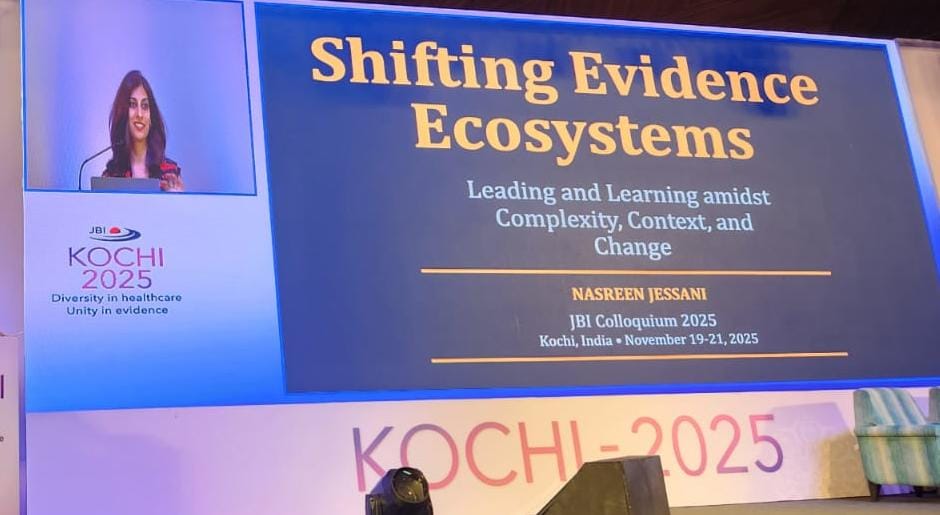
I attended the JBI Colloquium in Kochi last November, and I’ve been thinking about that event ever since. The conversations felt different. Not the usual defensive posture when evidence comes under attack, but something closer to shared recognition. In rooms filled with evidence synthesisers, guideline developers, and policy advisors from across the globe, there was acknowledgement that we’re at an inflection point.
The conversations weren’t about whether the evidence system needs transformation—that much was clear. They were about how.
I’ve spent two decades watching patterns repeat. Evidence is weaponised to justify predetermined conclusions. “Evidence-based policy” arriving as a Northern export: our problems, your solutions. Our contexts, your RCTs. Our urgencies, your timelines. But Kochi felt different because people in the room were naming these patterns out loud. Not as indictments, but as problems we need to solve together. Ultimately this is the system is broken. Not evidence—the system that decides what counts as evidence.
Here is a summary of my keynote speech where I urge those engaged in the evidence ecosystem to take more control of the narrative as well as the shifts that we need to see.
Everyone Loses in the Evidence Monoculture
Consider the evidence hierarchy we’ve inherited. RCTs and Systematic reviews at the top. Local knowledge at the bottom. As if a meta-analysis of Northern contexts published in Northern journals reviewed by Northern gatekeepers is inherently superior to what communities know from living through epidemics, droughts, and conflicts.
When 94% of editors at top medical journals are affiliated with high-income countries, that’s gatekeeping dressed as standards. When our heterogeneity gets treated as noise instead of signal, that’s epistemic injustice -some may go as far as calling it epistemic violence.
The evidence monoculture produces impressive yields—thousands of systematic reviews, millions of papers, hundreds of clinical practice guidelines. But like any monoculture, it’s brittle. And everyone loses. Not just those excluded from evidence production. Those included lose too, because evidence stripped of context is just data cosplaying as wisdom. Guidelines that travel poorly. Policies divorced from reality.
What We Must Learn
Real ecosystems don’t shift gently. They collapse and reconstitute. We’re living through that shift now, and it demands we relearn what evidence means.
Uncertainty is evidence’s natural state, not its failure mode. The current system performs certainty—statistical significance as punctuation mark, “evidence-based” as conversation ender. But that certainty is performed for funders and policymakers who mistake confidence intervals for confidence in action. Real evidence says: “Here’s what we know, with these caveats, in these contexts, for now.”
Context isn’t noise to filter out—it’s signal to amplify. When we make guidelines, or influence policies, we often treat context as an afterthought: develop the recommendation, then add caveats about “resource-limited settings.” This is backwards. Context is primary data. What works in Oslo may fail in Ouagadougou not because of “poor implementation” but because contexts differ in ways that matter more than the intervention itself.
Multiple evidence traditions answer different questions with equal rigour. Clinical trials, implementation science, traditional knowledge, community practice—these aren’t competitors. They’re complementary. But the current hierarchy treats only one as rigorous, dismissing others until validated by the dominant tradition.
Equity isn’t something to “integrate” into guidelines—it’s the purpose of having guidelines. If your guideline works for wealthy urban populations and fails for everyone else, it’s not an equitable guideline with implementation challenges. It’s a bad guideline.
Leading Through the Shift
Leadership in complexity doesn’t mean having answers. It means creating conditions where better questions emerge.
Convene differently: At your next meeting, audit who’s in the room. If everyone looks like you, works like you, was trained like you—stop. Identify whose voices are missing and refuse to finalize recommendations without them. Not as consultants. As co-creators with equal authority.
Fund Differently: Review your grant criteria this quarter. If “rigorous methodology” effectively means “Northern research methods,” you’re funding extraction. Rewrite requirements to fund evidence infrastructure where it’s needed. Set a target: X% of evidence generation funding going to institutions in contexts where the evidence will be applied.
Review differently: Track where manuscript submissions come from. If less than 20% originate from low- and middle-income countries, your journal is part of the problem. If all authors are foreign to the context that they write about – seek to understand the exclusion, request justification, and if necessary reject local knowledge being “stuck in the middle”. Recruit editors from underrepresented contexts—enough to shift the center of gravity.
Teach Differently: Dedicate equal time to multiple frameworks, realist synthesis, qualitative evidence synthesis, participatory approaches. Train students to recognize when each is appropriate, not to force everything into one hierarchy.
Reflect more: The next time someone says “we need more evidence before acting,” ask: More evidence, or more certainty? From whose context? And who benefits from delay? Then act on the evidence you have, with appropriate humility about uncertainty.
Build Better: Don’t wait for permission from global institutions to define what rigor means in your context. Convene regional networks. Establish African standards for African evidence. Build the infrastructure—journals, review boards, synthesis centers—that validate knowledge on your terms. The Africa Evidence Network exists as proof this is possible. Scale it.
Act now:
The question isn’t whether the ecosystem shifts. It’s already shifting. The question is whether we lead the shift toward justice and effectiveness, or manage the decline toward irrelevance.
Form coalitions across the evidence ecosystem. The systematic reviewer in Cape Town and the community health worker in Kampala and the traditional healer in Bamako aren’t competitors. They’re seeing different parts of the same system. Connect them. Fund those connections.
And when you see evidence being weaponized—used to delay action, justify cuts, maintain hierarchies—call it out publicly. Name it: policy-based evidence selection masquerading as evidence-based policy.
Evidence doesn’t need defending. It needs liberating from the system that’s suffocating it.
Kochi was the right place for that conversation. A city built by traders who knew that value comes from exchange, not extraction. Shaped by waves of influence that mixed without erasing.
Let go of what’s dying so what’s needed can emerge. What will you do differently?
About the author:

Dr. Nasreen Jessani is an extraordinary Associate Professor at Stellenbosch University, South Africa. She is a health policy and systems researcher with a track record working with national and international organisations in global health to advance evidence for impact. Nasreen’s primary research and practice sits at the nexus of health policy and systems research; innovations in evidence-informed policy and practice; and the relationship between academia and public policy. Her expertise lies in exploring innovative means of quantifying and describing the social and political dimensions of research use in health policy – and the subsequent ramifications for health system governance. She teaches Evidence Informed Decision Making (EIDM) relevant courses as well as Implementation Science. She is particularly interested in how the social, technical and political aspects of relationships and networks interact to advance EIDM.
Nasreen’s research and evaluation expertise is complemented by her leadership and management of large projects and programs including her visionary leadership as Head of the Knowledge, Impact and Policy Cluster at IDS, UK and former Program Officer at IDRC, Canada/Kenya, Head of Strategy for the Africa Evidence Network and contributions to the strategy of the WHO Coalition of Evidence. Nasreen also holds an Associate position at Johns Hopkins School of Public Health, USA and serves as on the WHO EVIPNet Global Steering Group. She used to serve on the Board of Directors for the Canadian Association of Global Health. She is also on the Steering Committee for World Evidence Based Health Care Day and Consulting Editor of Evidence and Policy Journal.
Originally from Kenya, Nasreen has lived and worked extensively in several countries including UAE, Pakistan, Bangladesh, Uganda, Senegal, Canada, USA, and South Africa. She holds a DrPH (Johns Hopkins University), MSPH (UNC-Chapel Hill), BSc (McGill University).
Acknowledgements: The author(s) is solely responsible for the content of this article, including all errors or omissions; acknowledgements do not imply endorsement of the content.
Disclaimer: The views expressed in published blog posts, as well as any errors or omissions, are the sole responsibility of the author/s and do not represent the views of the Africa Evidence Network, its secretariat, advisory or reference groups, or its funders; nor does it imply endorsement by the afore-mentioned parties.
Suggested citation: Jessani N (2026) Evidence Doesn’t Need Defending—It Needs Liberating: Keynote Reflections on shifting evidence ecosystems at the JBI Colloquium 2025. Blog posting on 20 March 2026. Available at: https://africaevidencenetwork.org/evidence-doesnt-need-defending-it-needs-liberating-keynote-reflections-on-shifting-evidence-ecosystems-at-the-jbi-colloquium-2025/2026/03/20/