
World Mosquito Day often generates awareness campaigns, social media messages and public education activities. In 2026, Sustainable Development for Health and Social Impact Initiative (SustiDev) wanted to move beyond online advocacy and take malaria prevention directly into a community setting.
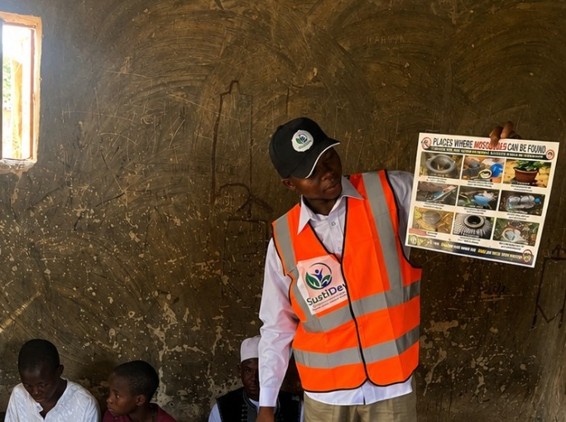
On 22 August 2026, SustiDev implemented a youth-led malaria prevention outreach at an Almajiri (traditional Qur’anic education) school in Bomo Ward, Sabon Gari Local Government Area, Kaduna State, Nigeria. The three-hour activity reached 23 people, including 16 children aged approximately 10-15 years and seven adults and community representatives. Fifteen mosquito nets were distributed.
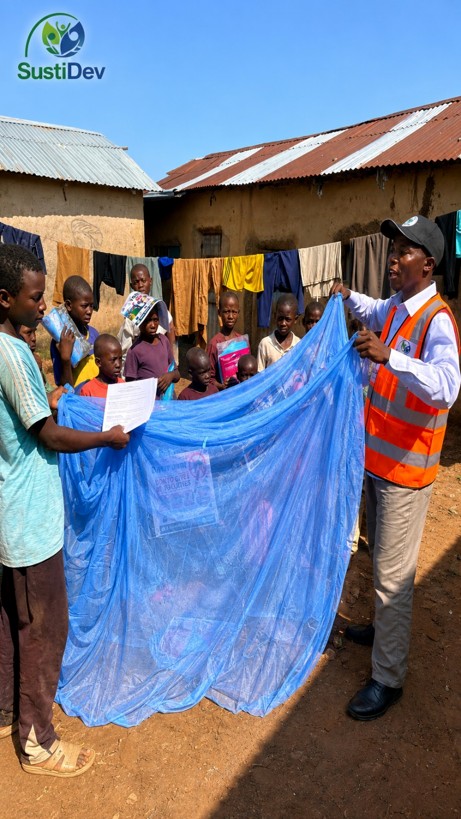
The outreach combined malaria education, mosquito-breeding awareness, environmental hygiene and source-reduction messages, a child-friendly “Mosquito Detectives” activity, mosquito-net demonstration and distribution, and a simple pre- and immediate post-awareness assessment. It was delivered in their local language (Hausa) using an interactive approach.
One of the most useful lessons, however, came not from what we taught, but from what we learned before teaching.
The baseline challenged our assumptions
Before the educational session, 16 participating children completed an individually administered awareness assessment. Questions were delivered verbally where necessary, and each child’s responses were recorded under an anonymous participant identifier.
The baseline findings were striking as every child scored 8 out of 9 on the scored knowledge questions, giving a mean baseline score of 88.9%. They already knew several practical malaria-prevention measures, including removing standing water, keeping the environment clean, sleeping under insecticide-treated nets and seeking appropriate care when malaria is suspected.
The high baseline score prompted an important question: where had this knowledge come from? The outreach facilitator later noted that the school had previously distributed mosquito nets to some children, which may have been accompanied by prevention messages. Guardians and other members of the community may also have been sources of information. The Almajiri system is a long-established form of Qur’anic education in northern Nigeria in which children, predominantly boys, study under traditional Islamic teachers. Participation in the system should not be treated as evidence of illiteracy, lack of awareness or absence of useful health knowledge. The children’s baseline responses were a practical reminder that community programmes should begin by finding out what people already know rather than assuming a deficit.
A specific gap with public-health importance
Despite their strong practical knowledge, all 16 children missed the same question at baseline: none correctly identified the mosquito responsible for transmitting malaria. Immediately after the session, all 16 answered that question correctly, and every participant achieved 9 out of 9 on the post-assessment.
The importance of this change is not simply the movement from 88.9% to 100%. The assessment revealed a distinction between knowing what to do and understanding why those actions matter. A child may know to sleep under a mosquito net or remove stagnant water without fully understanding the transmission pathway that links mosquitoes, malaria and prevention.
The outreach therefore addressed a specific conceptual gap in malaria-transmission knowledge among children who already demonstrated strong practical prevention knowledge. In simple terms, it helped connect some of the “what” of malaria prevention with the “why”.
What the children said
Children were asked to name one action they could take to help prevent mosquitoes around their home or community, and the responses were given verbally in Hausa. The outreach facilitator later recalled several responses that had stood out. These included “A rika amfani da gidan sauro lokacin bacci” – sleeping under an insecticide-treated net – and “A rika tsaftace magudanan ruwa domin kada ruwa ya tsaya” – keeping drainage channels clean so that water does not remain stagnant. These facilitator-recalled responses were consistent with the strong practical prevention knowledge seen in the baseline assessment; they were not systematically transcribed as formal qualitative data.
Community voice and child agency
A community leader expressed appreciation for the outreach and described it as a distinctive and welcome initiative. He particularly valued the mosquito-net distribution and felt the nets could make an important contribution to protecting the children from malaria. He also welcomed the emphasis on involving children directly, noting that they could share what they had learned with peers and family members.
That idea sits at the heart of SustiDev’s “Mosquito Detectives” approach. The children were not treated merely as recipients of information. They were encouraged to recognise what they already knew, correct misconceptions, relearn important concepts and see themselves as capable of carrying prevention messages beyond the activity.
Evidence does not have to begin with a large study
Evidence-informed decision-making is often associated with systematic reviews, large datasets, formal evaluations and research studies. These remain essential. But community organisations also make everyday decisions about what messages to prioritise, how to engage people, what assumptions to question and how to improve the next activity.
In Kaduna, a simple monitoring tool changed our understanding of the audience. It showed that the children did not lack malaria knowledge broadly; rather, they had strong practical knowledge alongside one specific gap in transmission knowledge. That is a different starting point for programme design.
Building evidence capacity while building youth leadership
The initiative had a second purpose. SustiDev’s volunteer model seeks to move young people beyond passive participation by giving them responsibility for real community activities. The Kaduna outreach was coordinated on the ground by SustiDev volunteer Abdullahi Umar Lawal.
Through the activity, the volunteer gained practical experience in public health advocacy, community engagement, facilitation, stakeholder coordination and field leadership. The outreach therefore created value in two directions: community members received malaria-prevention education and mosquito nets, while a young volunteer developed practical experience in delivering and documenting a public-health activity.
The wider lesson
The most important lesson from our World Mosquito Day outreach was simple: communities should not be approached only as recipients of information. They already possess knowledge, experiences and practices that programme implementers need to understand.
Evidence-informed community engagement begins by asking: What do people already know? What is actually missing? What assumptions are we bringing into the room? And what does the evidence suggest we should do differently?
For 16 children in one Almajiri community in northern Nigeria, a simple assessment helped answer some of those questions. It also reminded us that evidence is not only something produced at the end of a programme. Used carefully, it can shape how we understand people at the very beginning.
For SustiDev, that is the principle we hope to carry into future programmes: start with evidence, learn from the community, strengthen what people already know, address the gaps that genuinely exist, and allow what we learn to shape what we do next.

Note
The pre/post findings described here are immediate programme-monitoring results from a small group of 16 children. They should not be interpreted as evidence of sustained behaviour change, long-term knowledge retention or causal effectiveness.
Photographs: SustiDev World Mosquito Day 2026 field outreach, Kaduna State, Nigeria.
About the author
Idris Otun is a public health researcher and leads the Sustainable Development for Health and Social Impact Initiative (SustiDev), a nonprofit initiative focused on public health, sustainable development, youth capacity building and community action.
