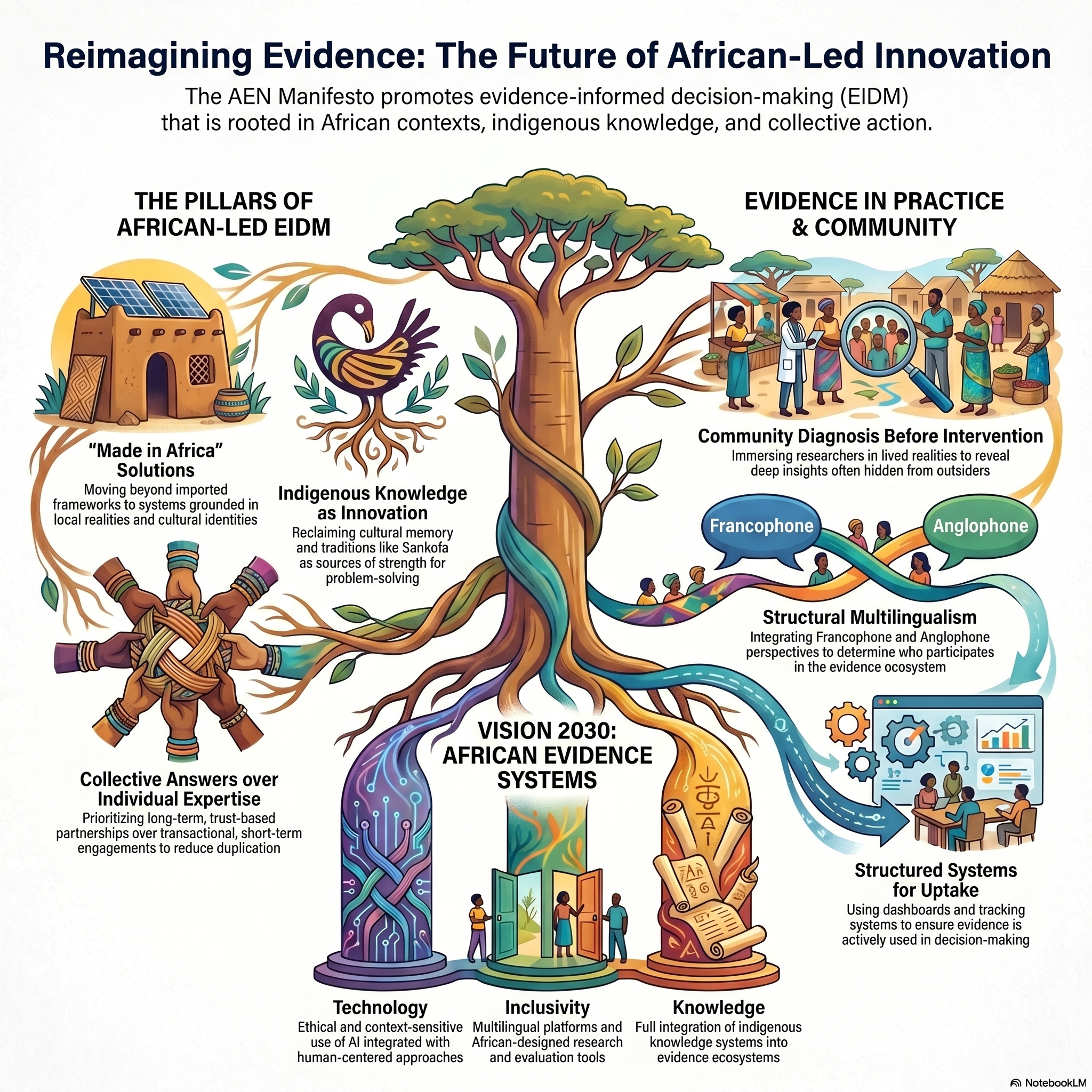
The Africa Evidence Network (AEN) Manifesto Innovation Challenge learning webinar went beyond a virtual convening, offering a collective reflection on how African-led innovation, inclusivity, and contextual knowledge can strengthen evidence-informed decision-making (EIDM) across the continent. Bringing together researchers, practitioners, storytellers, and evidence leaders from across Africa, it explored what truly African-led innovation looks like in practice. The discussion emphasised the need to move beyond imported frameworks towards approaches grounded in local realities, indigenous knowledge systems, and authentic partnerships, while also serving as a call to action for practitioners and organisations to submit entries to the challenge and showcase African-led innovations shaping EIDM.
The Manifesto as a living framework for African EIDM
Opening the session, Kirchuffs Atengble framed the AEN Manifesto as a collective declaration by African evidence practitioners on how capacity development for EIDM should be designed and practised. He emphasised its role in challenging dominant global models while advancing an Africa-centred approach grounded in context, equity, lived experience, and inspiration for strengthening evidence systems across the continent. Moderating the session, Dr Patrick Okwen reinforced “Made in Africa” approaches by linking discussions to efficiency, innovation, and the role of emerging technologies such as AI in shaping future evidence ecosystems. He encouraged reflection and dialogue, setting an inclusive tone of shared learning with his reminder that “the only wrong answer is the answer that is not given”.
African-led evidence ecosystems
A dominant theme throughout the webinar was the need to design and lead evidence systems grounded in African realities. Speakers emphasised that African contexts require African-centred solutions; ones that reflect local languages, cultural identities, and indigenous systems of knowledge. Imported development models, they noted, often fail when they are disconnected from the communities they are intended to serve. Instead, the AEN Manifesto was repeatedly positioned as a framework that legitimises African epistemologies and encourages locally grounded evidence production, use, and translation into policy.
Authentic partnerships and collective leadership
Prof Ruth Stewart, Director of the Alliance for Living Evidence (ALIVE), highlighted the centrality of authentic, trust-based partnerships to meaningful innovation in EIDM. She reflected on a shift from viewing individual expertise as the main driver of impact to recognising the importance of long-term, collaborative relationships grounded in shared purpose and mutual learning. Moving beyond transactional, short-term engagements, she emphasised partnerships as ongoing and adaptive. As she noted, “It’s not about one person having the answer. It’s about collective answers and collective working.” Such approaches, she argued, reduce duplication, strengthen responsiveness, and create more dynamic evidence systems that ensure relevant evidence reaches decision-makers effectively.
Structured systems for evidence use
Representing Sightsavers, James Ngerere highlighted the importance of structured systems in strengthening evidence uptake and organisational learning across more than 30 countries. He described how tools such as dashboards, tracking systems, and participatory research processes help ensure that evidence is not only generated but also actively used in decision-making. Drawing on case studies from Kenya and Sierra Leone, including disability-focused research that informed safeguarding guidelines and policy development, he emphasised that evidence must inform decisions for them to be meaningful. He further noted that innovation is not always about creating something new, but about strengthening systems that ensure evidence reaches the right users.
Knowledge rooted in culture and identity
Yolande Boudan’s contribution foregrounded the importance of culturally grounded innovation. Drawing on African philosophical traditions such as Sankofa, she reminded participants that meaningful progress often requires returning to indigenous knowledge systems. This idea reframes innovation not as abandonment of the past, but as a process of reclaiming cultural memory, identity, and wisdom as sources of strength. In this view, African-led innovation is inseparable from language, history, and community knowledge systems that have long shaped how societies solve problems.
Community co-creation and lived knowledge
Ayafor Lionel Ngwa delivered a memorable storytelling contribution illustrating how trust shapes evidence generation. Using the metaphor of a palm wine tapper whose knowledge is revealed only once he becomes part of the community, he showed that communities share their deepest insights only with those immersed in their lived realities. His message emphasised the importance of participation, immersion, and relationship-building in evidence work. He introduced “community diagnosis” as a practical approach that precedes intervention design, ensuring contextual understanding before action. As he noted, “If they see you as external to the story, they will not tell you the deep things about their experiences.”
Multilingualism and inclusive evidence systems
Merveille Miriam Ongolo highlighted the importance of multilingual engagement in strengthening African evidence ecosystems. By bringing together Francophone and Anglophone perspectives, the webinar demonstrated that language inclusion is not symbolic; it is structural. It determines who participates, whose knowledge is shared, and how evidence circulates across regions. Inclusive language systems, participants noted, broaden participation and enrich the quality of EIDM.
Audience reflections: redefining efficiency and innovation
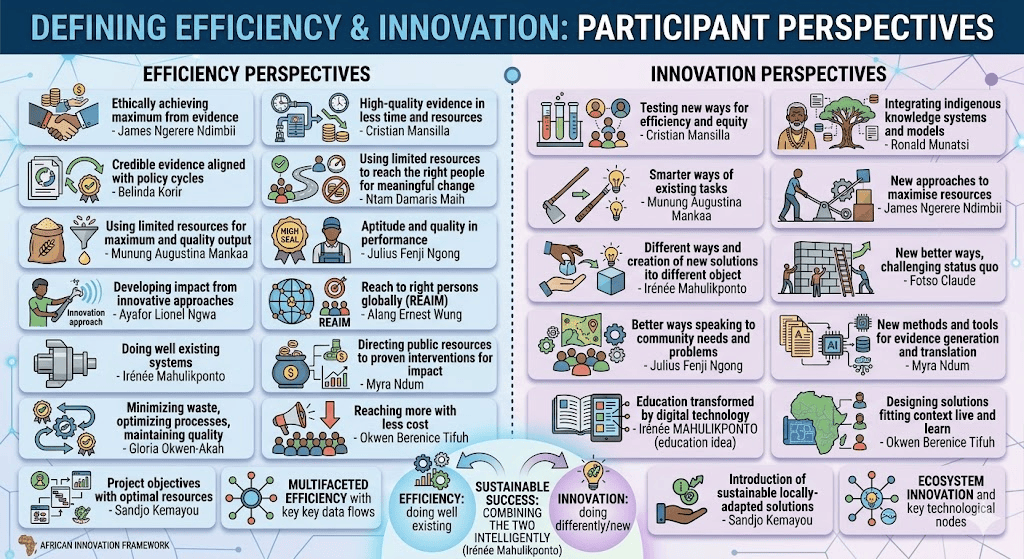
Audience engagement added significant depth to the discussion, with participants offering reflections that challenged conventional definitions of efficiency and innovation. Efficiency was reframed not as speed or cost reduction, but as generating actionable change, aligning research with policy cycles, producing meaningful impact with limited resources, and ensuring that evidence reaches the right decision-makers. Innovation was similarly redefined as smarter, context-specific problem-solving rather than technological novelty alone. One participant captured this succinctly, noting that “innovation is a smarter way of doing something people already do.”
Artificial intelligence and evidence ecosystems
A key area of discussion focused on the growing role of artificial intelligence in EIDM systems, with participants raising important questions about how AI might support or disrupt evidence ecosystems in Africa, including whether it can strengthen equitable access to evidence, how indigenous knowledge can be preserved alongside digital systems, and how African innovation can remain grounded in local realities amid rapid technological change. Rather than positioning AI as a replacement for human systems, the discussion emphasised the need for balance, integrating technology with indigenous knowledge and human-centred approaches.
A vision for African-led innovation by 2030
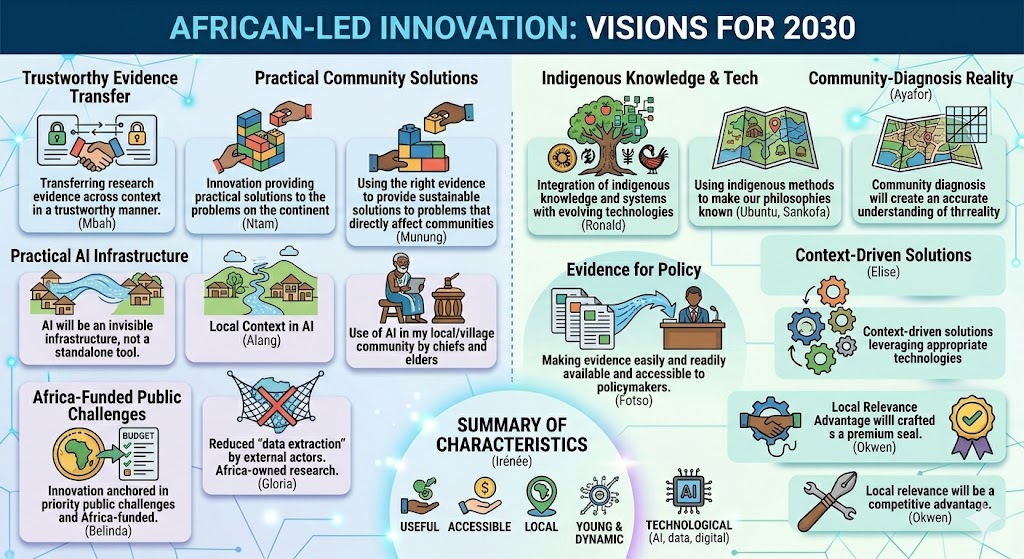
The webinar concluded with participants reflecting on what African-led innovation could look like in the future, with a shared vision that included ethical and context-sensitive use of AI, multilingual and inclusive evidence platforms, stronger community-led innovation systems, African-designed research and evaluation tools, and the full integration of indigenous knowledge systems into evidence ecosystems. These reflections pointed to a future in which African evidence systems are not only more inclusive but also more self-determined, contextually grounded, and globally influential.
Conclusion: a call to action for African evidence futures
The webinar highlighted that African-led innovation is already underway across communities, institutions, and partnerships, reshaping EIDM through structured systems, storytelling, indigenous philosophies, and collaborative research. It positioned the AEN Manifesto Innovation Challenge as a platform to document, recognise, and scale these efforts, with the closing date of 29 May offering a timely opportunity for engagement. Ultimately, it served as both inspiration and a call to action, reinforcing that African voices, realities, and leadership must shape Africa’s evidence future.
About the author: Charity Chisoro is a dedicated advocate for evidence-informed decision-making (EIDM) and capacity development, leading the Africa Evidence Network‘s efforts to enhance evidence capacities across Africa. With a strong academic background in Development Studies and Social Impact Assessment, Charity leverages over 5 years of strategic communications experience to drive social impact. As a passionate educator and mentor, Charity empowers learners and professionals alike while pursuing a PhD in Development Studies. Charity is committed to collaborating with like-minded individuals to foster positive change and advance evidence-driven practices.
Acknowledgements: The author is solely responsible for the content of this article, including all errors or omissions; acknowledgements do not imply endorsement of the content.
Disclaimer: The views expressed in published blog posts, as well as any errors or omissions, are the sole responsibility of the author/s and do not represent the views of the Africa Evidence Network, its secretariat, advisory or reference groups, or its funders; nor does it imply endorsement by the afore-mentioned parties.
Suggested citation: Chisoro C (2026) Reimagining evidence in Africa: Insights from the AEN Manifesto Innovation Challenge webinar. Blog posting on 20 May 2026. Available at: https://africaevidencenetwork.org/reimagining-evidence-in-africa-insights-from-the-aen-manifesto-innovation-challenge-webinar/2026/05/20/