
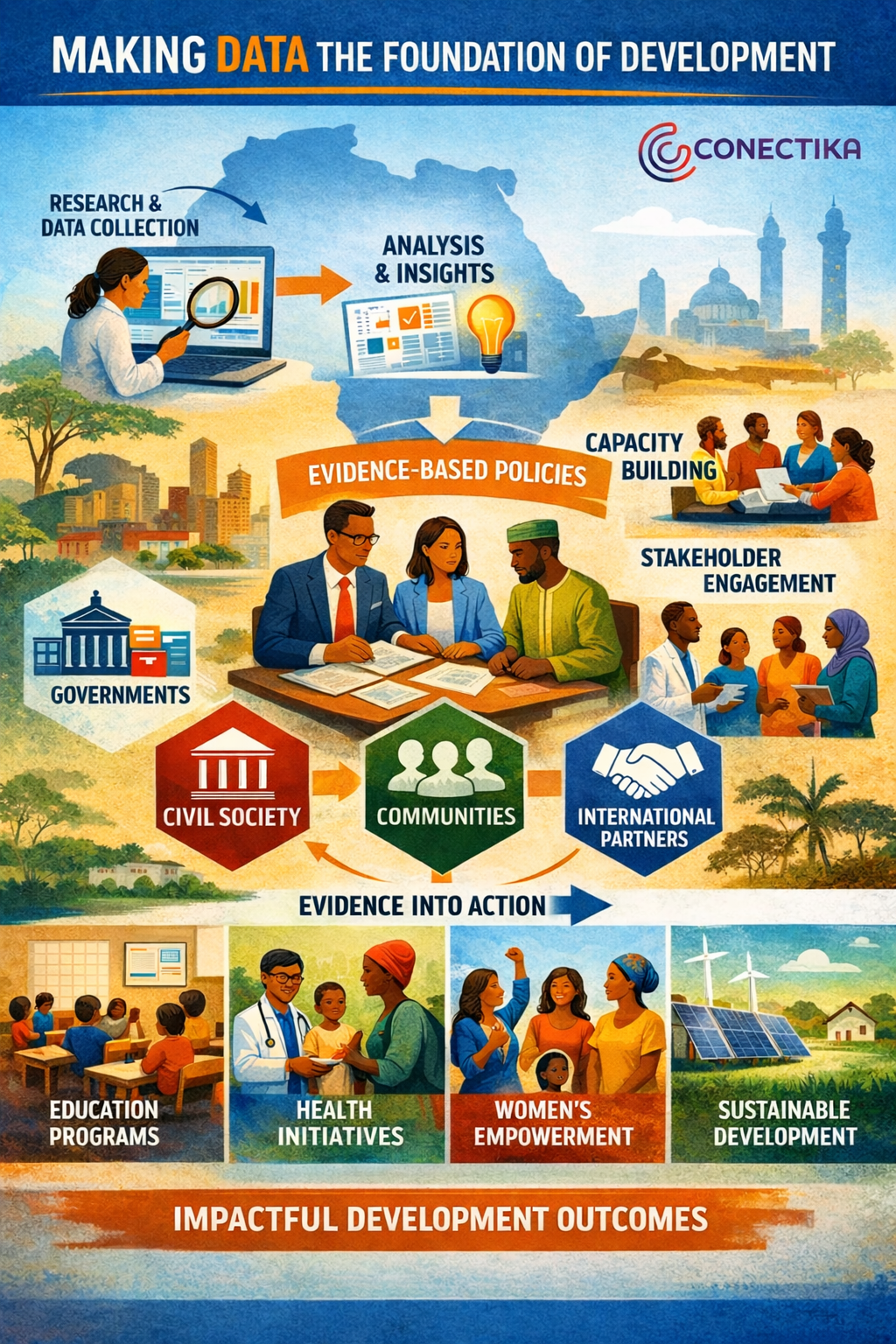
Across Africa, data is extensive and diverse, yet its potential to effectively shape public policy is not always fully realised. Making the most of this data can transform knowledge into policies and actions that generate tangible development outcomes. Bridging the gap between knowledge and action is therefore crucial to advancing sustainable and inclusive development across the continent.
It is within this context that CONECTIKA operates. As a newly established organisation, CONECTIKA builds on extensive experience in policy, research, and strategic communication to support evidence-informed decision-making. Based in Dakar, the organisation is dedicated to transforming data and knowledge into practical decision-making tools. Through an integrated, evidence-driven approach, it ensures that data serves as a foundation for designing and implementing policies, programmes, and development strategies.
From Data to Decisions: Strengthening Institutions
In increasingly complex policy environments, decision-makers require more than data; they need robust analysis and actionable insights to guide their choices.
Supporting governments, civil society organisations, and development partners in this process is critical. This includes contributing to policy formulation, strengthening institutional systems, and improving programme design. Translating complex research into clear, practical recommendations allows for more efficient resource allocation and more effective interventions. It also reinforces institutional positioning and strategic growth by aligning decisions with real needs and priorities.
Making Data Usable: From Information to Actionable Knowledge
Producing data is not enough; data must be understood and used.
Transforming complex information into accessible and actionable knowledge is essential to ensuring that evidence informs real decisions. This requires a strong focus on clarity, relevance, and usability.
In multi-country and multi-sector initiatives, data collection, analysis, and interpretation help identify key trends, challenges, and opportunities. These insights inform critical decisions across the policy cycle, from strategy design and implementation to resource mobilisation and allocation. In this way, research becomes a practical tool that strengthens public policies and drives improved outcomes on the ground.
Building Capacity and Engaging Stakeholders
Embedding evidence into decision-making processes requires both strong capacities and inclusive approaches.
Strengthening institutions’ and stakeholders’ ability to use data effectively is therefore essential. Through trainings, collaborative work sessions, peer learning, and knowledge-sharing platforms, a culture can be fostered in which evidence informs strategic decisions.
Equally important is meaningful stakeholder engagement. Policies and programmes are more effective when they are co-designed with those they impact. Facilitating dialogue among governments, civil society, private-sector actors, and communities ensures that evidence is not only produced but also understood, adopted, and applied.
Adapting to Context: One Size Does Not Fit All
Africa’s diversity calls for context-sensitive solutions. Approaches that succeed in one country may not be effective in another.
Combining local knowledge with international best practices enables the design of strategies that are culturally informed, contextually relevant, and adaptable. This is particularly important in regional and multi-country initiatives, where harmonising methodologies and ensuring data comparability must go hand in hand with respecting national and local realities. Striking this balance allows for both consistency and relevance in the use of evidence.
Early Initiatives and Outputs
- As a newly established organisation, CONECTIKA has laid the technical foundations for initiatives that demonstrate the practical value of evidence-informed approaches.
- Conceptualisation of a programme to support the socio-economic reintegration and empowerment of women victims of gender-based violence, informed by data on social dynamics, risks, and observed trends.
- Technical note on developing a pedagogical pathway for integrating digital tools in primary schools, based on research and evidence on learning outcomes and digital readiness.
- Socio-economic restructuring and reintegration programme for women street vendors in Senegal, guided by data on livelihoods, urban inclusion, and market dynamics.
- Support to local CSOs in implementing actions to prevent human rights violations, informed by evidence on community risks, existing interventions, and local priorities.
- Concept note for an online knowledge management and sharing platform across Africa, designed to centralise, structure, and make accessible the continent’s research, innovations, best practices, and policy-relevant knowledge, ensuring that data informs decision-making and learning across sectors.
- Looking ahead, CONECTIKA aims to strengthen its work by partnering with large-scale initiatives like the Africa Evidence Network (AEN), supporting evidence-informed programmes, building capacity across governments, civil society, and communities, and co-designing tools, alongside research and data, to guide inclusive, context-sensitive, and impactful development throughout Africa.
Addressing the Barriers to Effective Data Use
- Making data the foundation of development requires more than producing information; it requires actively addressing the barriers that limit its use.
- Technical and data-related barriers can be overcome by improving data quality, accessibility, and relevance, and by ensuring that research orientation and focus align with the priorities of both decision-makers and the communities they serve.
- Capacity gaps require targeted training, peer learning, and strengthened systems to support data analysis and use.
- Organisational constraints can be overcome by fostering a culture of evidence use among decision-makers and development practitioners, providing training to develop an evidence-based mindset, promoting collaborative work among institutions, organisations, stakeholders, and community representatives, showcasing successful evidence-based outcomes, and supporting evidence use in practice.
- Contextual and political factors must be considered by aligning data efforts with policy priorities and ensuring adequate resources and timing.
- Communication challenges require tailored knowledge products, policy briefs, visuals, and learning sessions that make data clear, actionable, and accessible.
Towards Evidence-Informed Development
Placing data and knowledge at the centre of decision-making drives a broader transformation in how development is approached across Africa, supporting the emergence of policies that are more effective, equitable, and sustainable. Making data the foundation of development is not simply about producing more information; it is about creating the conditions for its effective use: listening to communities from the start, strengthening capacities, adapting approaches to context, and fostering collaboration between data producers, users, and decision-makers. Through its early work and ongoing initiatives, CONECTIKA is helping build a future where decisions are guided by evidence, policies are grounded in reality, and development interventions generate lasting impact for communities across the continent.
About the author:

Aminata Diagne Barre is a specialist in policy, research, and knowledge with over 15 years of experience supporting development and humanitarian initiatives across West and Central Africa. As Founder of CONECTIKA, she works to ensure that data and evidence meaningfully inform policies and actions by translating insights into practical tools for programs, strategies, and interventions. Her work bridges knowledge, policy, and practice to contribute to inclusive and sustainable development outcomes.
Acknowledgements: The author(s) is solely responsible for the content of this article, including all errors or omissions; acknowledgements do not imply endorsement of the content. The author is grateful to Charity Chisoro for her guidance in preparing and finalising this article, as well as her editorial support.
Disclaimer: The views expressed in published blog posts, as well as any errors or omissions, are the sole responsibility of the author/s and do not represent the views of the Africa Evidence Network, its secretariat, advisory or reference groups, or its funders; nor does it imply endorsement by the afore-mentioned parties.
Suggested citation: Barre A D (2026) Making data the foundation of development. Blog posting on 20 April 2026. Available at: https://africaevidencenetwork.org/making-data-the-foundation-of-development/2026/04/20/
