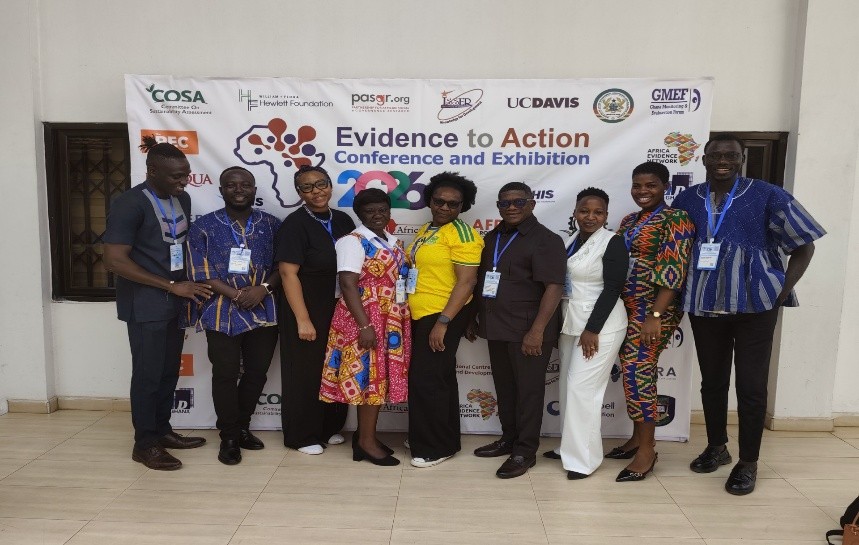
The 9th Evidence to Action (E2A) Conference and Exhibition is organised by the International Centre for Evaluation and Development (ICED) and the University of California, Davis, in collaboration with the Institute of Statistical, Social and Economic Research (ISSER) and other partners. Hosted at the ISSER Auditorium at the University of Ghana in Accra from 22–26 June 2026, the conference brought together diverse actors across Africa’s evidence ecosystem.
After E2A 2026, the energy of the gathering still lingers. Conferences often move quickly sessions, panels, side meetings, exhibitions, reunions, and new introductions and it is only once the dust settles that the deeper meaning becomes clear. This year’s E2A was more than an event; it was a powerful reminder of the collective strength, creativity, and determination driving Africa’s evidence movement forward.
As I reflect on the experience, several themes stand out: the power of connection, the affirmation of leadership, the joy of community, and the clarity of purpose that emerges when people committed to evidence-informed decision-making come together.
The Power of Connection
One of the most memorable moments of E2A 2026 was meeting our new AEN Director in person for the first time. Digital collaboration has its strengths, but nothing replaces the grounding impact of face-to-face connection. Sharing space, exchanging ideas, and experiencing the energy of leadership in real time brought a renewed sense of alignment and excitement for the future of the Africa Evidence Network (AEN).
Equally meaningful was the opportunity to connect with AEN members in Ghana. Their warmth, curiosity, and commitment to strengthening evidence ecosystems reminded me why the network exists to bring people together across borders, disciplines, and institutions. These interactions were not just professional exchanges; they were moments of community-building that reaffirmed the value of belonging to a continental movement.
Connection Through the Exhibition Stand
One of the most energising parts of E2A 2026 was spending time at our exhibition stand. It became a true meeting point a space where I connected not only with AEN members but also with many non‑members who were curious about the network, our work, and the broader evidence ecosystem. The stand allowed for organic, meaningful conversations: some people came with specific questions, others simply wanted to learn, and many were excited to discover a community they had not yet engaged with.
These interactions reminded me how powerful visibility is. When people can walk up, ask questions, share their experiences, and see themselves reflected in the work, the network grows in both depth and reach. The stand became a place of discovery, connection, and storytelling a microcosm of what the Africa Evidence Network represents.
Sharing South African sweet treats added a personal touch that sparked joy and conversation. It created a warm, welcoming atmosphere and made the stand feel less like an information point and more like a community space. Those small moments of hospitality helped build rapport and made people linger longer, opening the door to richer engagement.
Engaging Young and Emerging Leaders
A particularly inspiring aspect of the exhibition stand was the opportunity to interact with young and emerging leaders from the Africa Evidence Youth League (AEYL). These conversations were vibrant, hopeful, and deeply grounding. We met aspiring members eager to join the evidence movement, current members actively shaping youth-led initiatives, and past members who continue to carry the spirit of the Youth League into their professional journeys.
Their passion for evidence-informed decision-making, their curiosity about the network, and their commitment to contributing meaningfully to Africa’s future were powerful reminders of why intergenerational collaboration matters. The Youth League represents not just the future of evidence work but its present. Their voices, ideas, and leadership are essential to building ecosystems that are innovative, inclusive, and sustainable.
Engaging with them reinforced the importance of creating pathways for young leaders to participate, influence, and lead. It also highlighted the responsibility we carry as established practitioners to mentor, support, and open doors for the next generation.
Affirmations of Leadership
E2A 2026 offered a powerful affirmation of what leadership in the evidence space looks like today and what it must continue to become. The conference highlighted the importance of inclusive, equitable evidence ecosystems, where diverse voices shape the agenda and young leaders are not only invited but centred.
For me, the week reinforced the value of leading with clarity, consistency, and connection. It affirmed that leadership is not only about strategy and systems; it is also about presence, relationships, and the ability to create environments where others feel seen and empowered.
The conversations, panels, and informal exchanges reminded me that Africa’s evidence movement is strongest when leadership is shared when we build bridges across countries, institutions, and generations. E2A 2026 made it clear that the future of evidence-informed decision-making will be shaped by leaders who embrace collaboration, nurture networks, and champion African-led innovation.
Shifts in Perspective
After the event, I find myself thinking not only about what happened at the conference, but what shifted because of it.
There is a clearer sense of where Africa’s evidence movement is heading:
- More localisation of evidence agendas
- More youth leadership and intergenerational collaboration
- More cross-country partnerships
- More intentional systems thinking
The conference also highlighted gaps that still require attention institutional capacity, political buy-in, and sustainable funding models. These are not new challenges, but E2A 2026 sharpened the urgency of addressing them with creativity and collective action.
Personally, the conference shifted my focus toward long-term integration. Instead of seeing events as standalone moments, I am thinking more about how insights from E2A can be woven into organisational rhythms, Executive Committee (EXCO) processes, staff development, and network engagement. Reflection is not just about looking back; it is about deciding what to carry forward.
Carrying the Momentum Forward
After a major conference is often where momentum is lost emails pile up, routines return, and the inspiration of the event begins to fade. But E2A 2026 left me with a clear sense of what must be carried forward intentionally.
I want to carry forward:
- Consistency in communication: predictable rhythms that keep teams aligned and connected.
- Strengthened partnerships: nurturing the relationships sparked or deepened at E2A.
- Amplification of African evidence voices: ensuring that innovations and leadership from across the continent are visible and celebrated.
- Youth empowerment: creating spaces where young evaluators and policy actors can lead, influence, and shape the future.
- Human connection: the small gestures, shared moments, and cultural exchanges that make our work meaningful.
These commitments are not abstract. They are practical, actionable, and aligned with the long-term vision of building evidence ecosystems that are resilient, inclusive, and rooted in African realities.
The Emotional Truth of E2A 2026
Beyond the sessions and speeches, E2A 2026 carried an emotional resonance that is difficult to capture in formal reports.
I felt pride: in the continent, in the work, in the community.
I felt gratitude: for the connections, the conversations, the shared purpose.
I felt determination: to keep pushing for evidence-informed governance even when the work is slow or politically complex.
I felt groundedness: knowing that transformation is a long game, and that we are playing it with intention.
These emotions matter. They shape how we lead, how we collaborate, and how we sustain momentum long after the conference ends.
Looking Ahead
As the organisers prepare to share conference highlights, photos, recordings, and the final report, I am reminded that the conversations do not end with the closing ceremony. E2A 2026 was a moment in a much larger movement one that continues through our daily work, our partnerships, and our collective commitment to transforming evidence into action.
After the event, I remain inspired, energised, and deeply connected to the community that makes this work possible. The future of evidence in Africa is bright, and it is being built by all of us one connection, one collaboration, one shared purpose at a time.
About the author: Siziwe Ngcwabe is the former Director and Co-chair of the Africa Evidence Network (AEN) and currently serves as the Director of People and Operations at the Pan-African Collective for Evidence She is a South African People & Operations Leader, Strategic EIDM Practitioner, Organisational Culture & Systems Architect, Social Worker, Coach & Mentor, and an Equity & Inclusion Advocate committed to strengthening communities and leadership across the continent
Siziwe played a pivotal role in advancing the mission of the Africa Evidence Network. In her leadership, she championed the use of evidence to drive meaningful change across Africa and supported the growth of a vibrant, collaborative evidence ecosystem. Her work has consistently promoted evidence production, use, and mediation to improve policy and practice, contributing to stronger institutions, more connected communities, and a more resilient evidence movement.
Across her 30‑year career, Siziwe has worked in several organisations and sectors in South Africa, approaching each environment with dedication, diligence, and a deep commitment to people‑centred leadership. She is recognised for her ability to design and strengthen organisational systems that serve people, advance justice, and build sustainable impact across Africa. Her leadership is rooted in purpose, equity, and the belief that empowered people create empowered institutions.
She remains committed to building innovative, collaborative solutions and strengthening connections across African and global evidence communities ensuring that systems, organisations, and leaders are equipped to deliver equitable, sustainable, people‑centred transformation.
Acknowledgements: The author is solely responsible for the content of this article, including all errors or omissions; acknowledgements do not imply endorsement of the content. The author is grateful to Lenah Kitenge and Jiyaad Armien for their guidance in preparing and finalising this article, as well as their editorial support.
Disclaimer: The views expressed in published blog posts, as well as any errors or omissions, are the sole responsibility of the author/s and do not represent the views of the Africa Evidence Network, its secretariat, advisory or reference groups, or its funders; nor does it imply endorsement by the aforementioned parties.
