Introduction
On 1 April 2026, the Africa Evidence Network (AEN) hosted a bilingual Manifesto Innovation Challenge Information Session that brought together researchers, policymakers, and practitioners from across the continent. More than just a briefing, the session was a rallying call: a chance to celebrate African ingenuity, spotlight values‑driven innovation, and prepare members to submit their ideas for recognition during Africa Evidence Week 2026. The session was opened and closed by Siziwe Ngcwabe, who framed the challenge’s importance in the present and reminded participants of the collective journey ahead.
Key Takeaways from the Session
The session brought together diverse voices to highlight the challenge’s strategic vision, practical pathways, and inclusive spirit. Together, these reflections guided members from the why of the Challenge, through the how of participation, to the assurance that no voice or language will be left behind.
From Stories to Spotlight: From Reflection to Recognition
Divine Adongo emphasised the importance of moving beyond reflection to recognition, urging African innovators not only to share stories but also to spotlight successes, turning lessons into policy blueprints for the continent. He stressed that Africa’s innovation journey must be asset‑based, recognising existing expertise and shifting from “capacity building” to “capacity sharing.” For Divine, the challenge is not about scarcity but about visibility: ensuring African solutions are recognised, celebrated, and scaled.
He illustrated this vision with practical examples that members could consider. These included mapping the continent’s strengths by using the AEN database to identify African experts and centres of excellence, making evidence sharing a two‑way street through twinning programmes between countries, certifying evidence champions by working with national governments to formalise AEN participation as a professional credential, and turning member stories into policy spotlights by creating high‑visibility showcases for African ministers.
Together, Divine’s reflections underscored that Africa’s innovation challenge is not about importing solutions but about recognising and amplifying the expertise already present. By mapping strengths, sharing capacity, certifying champions, and spotlighting successes, Africa can move confidently from stories to spotlight and from reflection to recognition.
From Idea to Impact: Navigating the Challenge Process
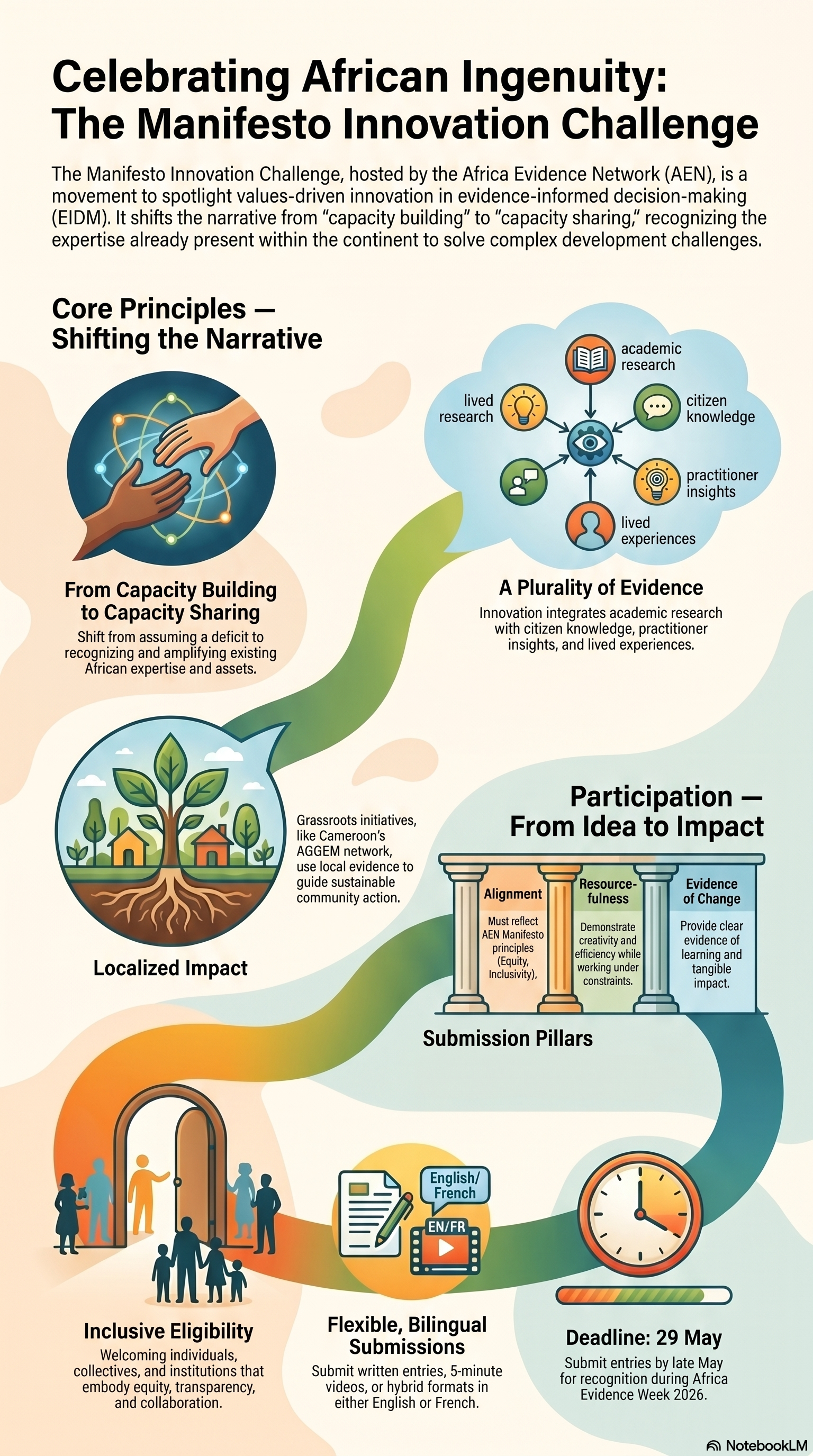
Charity Chisoro guided participants through the practical heart of the Manifesto Innovation Challenge, ensuring everyone understood how to participate effectively. She explained that eligibility is broad, welcoming individuals, collectives, networks, and institutions whose initiatives embody the Manifesto principles of equity, inclusivity, transparency, and collaboration. Submissions should be recent and active, reflecting innovation under constraints and values‑led practice.
She emphasised that the application format is designed to be accessible, offering options for written entries of up to 1,200 words, short videos of up to 5 minutes, or hybrid submissions in either English or French. Charity outlined the guiding sections applicants should cover — context, actions taken, alignment with the Manifesto, efficiency in resource use, and evidence of learning and change — all intended to help members tell their stories in a structured yet authentic way.
Finally, she reminded participants of the key dates: submissions close on 29 May, with recognition to follow during Africa Evidence Week. More than just a competition, she framed this challenge as a collective learning journey — a chance to showcase African creativity, strengthen resilience, and celebrate principled practice across diverse contexts.
From Language to Inclusion: From Voice to Visibility
Andrea Elanga delivered her reflections in French, a powerful reminder that innovation in Africa is inherently multilingual and inclusive. By speaking directly to Francophone members, she affirmed that the Manifesto Innovation Challenge is designed to leave no one behind. Her address highlighted that innovation does not have linguistic boundaries — it lives in every context, and it must be recognised in the languages of lived practice.
She encouraged submissions from Francophone communities, noting that bilingual access ensures African innovators can share their stories authentically and confidently. Andrea illustrated how small, everyday adaptations — such as using local meetings to share evidence — can transform decision‑making processes. She reminded participants that innovation is not always about technology or scale, but about creativity rooted in everyday realities.
Her reflections closed with a call to action: Francophone members should feel assured that their voices matter and their experiences inspire. By opening submissions in both French and English, the challenge ensures that innovation is celebrated in all its diversity, strengthening inclusivity across Africa’s evidence ecosystem.
From Constraints to Creativity: From Practice to Principle
Kirchuffs Atengble moderated a fireside conversation with Eric Ngang and Nain Mirabel Yuh, who shared personal experiences of working creatively within constraints. Together, their reflections grounded the session in lived realities, showing that innovation in Africa is both practical and principled — a blend of creativity, resilience, and values‑driven practice.
Valuing and Sharing Existing Knowledge: An Asset for Africa’s Development
Eric Ngang spoke about innovation projects he has been part of, particularly those that leveraged community knowledge and grassroots participation to inform local policy. He highlighted how small‑scale initiatives, when rooted in local realities, can ripple outward to influence broader decision‑making.
He reminded participants that Africa’s journey toward sustained, transformative development increasingly depends on how well decisions are informed by diverse forms of evidence. Evidence, he emphasised, is not limited to academic research alone; it includes data, citizen knowledge, practitioner insights, and lived experiences — and how this knowledge is generated and shared. This diversity is essential because complex development challenges require solutions grounded in multiple realities, not a single narrative.
A key message from the AEN Manifesto is the shift from “capacity building” to “capacity development” or even “capacity sharing.” Rather than assuming a deficit in African systems, this approach recognises existing knowledge and strengthens it through collaboration. Evidence ecosystems — comprising producers, users, and intermediaries — must work together to co‑create knowledge that is relevant, timely, and actionable. Importantly, Eric stressed that effective decision‑making must integrate the voices of often marginalised groups, including communities, civil society, and local practitioners.
He illustrated this through the case led by the Action Group on Governance and Environmental Management (AGGEM) in Cameroon. Through a network of over 80 civil society organisations, a “demand and supply of capacity” model was implemented to promote peer-to-peer learning and local ownership of knowledge to address day-to-day challenges. Instead of relying heavily on external expertise, organisations pooled their internal skills, shared experiences, and jointly addressed capacity gaps.
What makes the Cameroon example powerful, Eric explained, is its demonstration of localisation. Communities and organisations defined their own development priorities and leveraged local evidence to guide action. External support was only sought when necessary, ensuring that interventions remained contextually relevant and sustainable.
Ultimately, Eric concluded that embracing diverse evidence strengthens both the legitimacy and effectiveness of decisions that address intertwined challenges. Africa’s development future lies in recognising that knowledge is plural, context matters, and sustainable change happens when people are not just recipients of solutions, but active contributors to them.
From Collaboration to Co‑Creation: From Inclusion to Impact
Nain Mirabel Yuh brought a powerful perspective to the conversation, emphasising that innovation thrives when inclusivity is at the centre of practice. Drawing on her work in Bamenda, she described how projects flourish when the voices of beneficiaries — such as persons with disabilities — are actively involved in programme design. For Nain, innovation is not only about generating new ideas but about co-creating solutions with diverse stakeholders, ensuring that evidence is usable, accessible, and trusted by those it is meant to serve.
Her reflections highlighted that collaboration and inclusivity are not optional add-ons but essential drivers of values-driven innovation in Africa. By embedding community voices into decision-making, practitioners strengthen both the legitimacy and the impact of their interventions. Together with Eric’s emphasis on valuing existing knowledge, Nain’s call for inclusivity shows that Africa’s innovation story is built on two pillars: recognising the evidence already present in communities and ensuring that all voices are part of shaping solutions.
From Everyday Practice to Collective Voice
Aminata Diagne Barre emphasised that innovation in African contexts often emerges from working creatively with what is already available rather than waiting for external resources. She highlighted the importance of recognising everyday practices as innovations in their own right — from community‑driven solutions to grassroots initiatives that respond directly to local needs. Her reflections reinforced Divine’s call to move from stories to spotlight. They echoed Nain’s emphasis on collaboration and inclusivity, reminding participants that innovation is not only about formal projects but also about valuing the voices and practices of members across the continent. In this way, Aminata’s contribution ensured that the audience actively shaped the dialogue, grounding the Challenge in the lived realities of African practitioners.
Conclusion
The session made clear that the Manifesto Innovation Challenge is more than a competition; it is a collective movement to recognise and celebrate African creativity in evidence‑informed decision‑making (EIDM). Speakers highlighted the need to move from stories to spotlight and from reflection to recognition, stressing that Africa’s innovation journey must be asset‑based and context‑driven. They pointed to practical innovations such as mapping strengths through the AEN database, fostering peer‑to‑peer twinning across countries, certifying evidence champions, and turning member stories into policy showcases. At the same time, they underscored that participation must remain broad and accessible, with formats that capture authentic practice and bilingual inclusivity, ensuring no voice is left behind. Grounded in lived realities, the reflections showed that Africa’s strength lies in its ability to innovate under constraints, pooling knowledge and centring inclusivity to transform everyday practices into sustainable pathways for evidence use.
About the authors:
Charity Chisoro is a dedicated advocate for evidence-informed decision-making (EIDM) and capacity development, leading the Africa Evidence Network‘s efforts to enhance evidence capacities across Africa. With a strong academic background in Development Studies and Social Impact Assessment, Charity leverages over 5 years of strategic communications experience to drive social impact. As a passionate educator and mentor, Charity empowers learners and professionals alike while pursuing a PhD in Development Studies. Charity is committed to collaborating with like-minded individuals to foster positive change and advance evidence-driven practices.
Eric Ngang is an expert in environment, sustainability, and governance with extensive experience across Africa. He specialises in inclusive strategies that centre equity and protect vulnerable populations affected by mining and climate change. With a strong track record in cross‑sector collaboration, climate risk assessments, and advising civil society and international partners, Eric prioritises deliberative processes that keep communities at the heart of decision‑making. His contributions to policy influence on climate change, localisation, and energy transition through engagements with the UN and African Union reflect his commitment to advancing resilience, equity, and African‑led sustainability solutions.
Nain Mirabel Yuh is a seasoned programme manager for Gender Equity and Inclusion at eBASE Africa, with a strong background in research implementation and innovation. She leverages best practices to improve the livelihoods of underserved populations, particularly people with disabilities. With expertise in qualitative and quantitative research, Yuh develops innovative tools and solutions to drive positive change. Her extensive experience spans research design, data collection, project implementation, and presentation. A collaborative team player, Yuh has worked across various departments and projects, fostering a spirit of partnership and teamwork. She is driven by the conviction that building an inclusive Africa, where no one is left behind, is a collective responsibility that requires dedicated effort and commitment, especially for people with disabilities.
Acknowledgements: The authors are solely responsible for the content of this article, including all errors or omissions; acknowledgements do not imply endorsement of the content.
Disclaimer: The views expressed in published blog posts, as well as any errors or omissions, are the sole responsibility of the author/s and do not represent the views of the Africa Evidence Network, its secretariat, advisory or reference groups, or its funders; nor does it imply endorsement by the afore-mentioned parties.
Suggested citation: Chisoro C, Ngang E & Yuh NM (2026) Celebrating African Ingenuity: Insights from the Manifesto Innovation Challenge Information Session. Blog posting on 20 April 2026. Available at: https://africaevidencenetwork.org/celebrating-african-ingenuity-insights-from-the-manifesto-innovation-challenge-information-session/2026/04/20/
