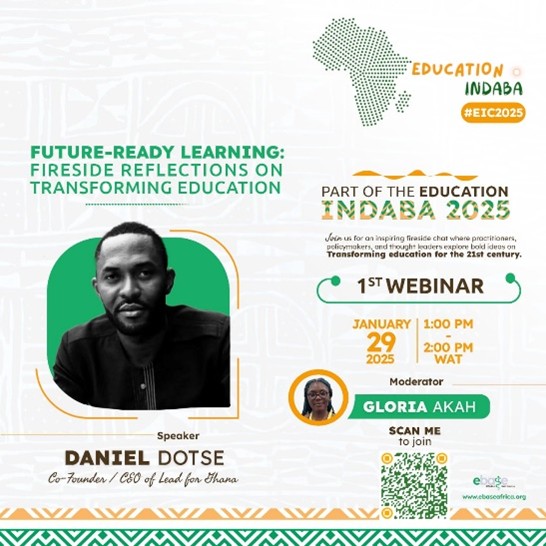
The Education Indaba Webinar Series, which focused on fostering innovative thinking and collaboration in education across Africa and beyond, kicked off with an inspiring session. Bringing together educators, researchers, policymakers, and thought leaders, the series aims to explore transformative ideas in education. Specifically, we reflected on ideas aimed at transforming education in Africa’s youthful population, we explored strategies for harnessing limited resources within Africa and discussed how communities can catalyse education transformation within the country or continent. We were also out to inspire a long-term vision for the next century of learning by sharing powerful stories of innovation, community-driven initiatives, and the potential for collective impact.
Connecting to Pressing Education Issues
The Pre-Conference Webinar Series serves as a thought-provoking platform to initiate high-level dialogue ahead of the Education Indaba 2025. Targeting educators, policymakers, researchers, and funders, the series inspires participants to think critically and innovatively about educational challenges in sub-Saharan Africa, particularly in regions like the Lake Chad Basin. The webinars emphasise engaging, non-conventional formats that invite participation, foster creativity, and break away from traditional online discussions.
Innovative Strategies for Transforming Education in Africa
This session featured Daniel Dotse, co-founder and CEO of Lead for Ghana. Daniel shared his journey and strategies for transforming education in Africa. His work emphasises the importance of creating solid educational systems to develop future engineers and leaders. One key point was the need for affordable and rapid education. Daniel highlighted the potential of technology and artificial intelligence to prepare children for a constantly changing world.
Recruiting highly skilled, motivated, and knowledgeable teachers is crucial. Daniel stressed that teachers should act as education champions, and education should be treated with a high sense of emergency by engaging parents and communities, especially in rural areas where the value of education may not be well recognised. Long-term strategies include developing future leaders who prioritise education, ensuring that policies are informed and investments in education are made wisely. Policies that require leaders to have teaching experience could result in more informed decisions and investments in education, ultimately providing equal opportunities for all children.
Transformative Ideas and Experiences
Daniel’s personal experiences shed light on the disparities in education within Ghana. His mother moved him and his brother to Accra for better schooling, highlighting how geographical location impacts education quality. This inspired Daniel to build a library in the Volta region. Collaborating with Books for Africa, he secured 30,000 books and partnered with the Ghana government to establish a modern library. However, he realised that merely building libraries wouldn’t solve broader educational issues, leading him to focus on systemic problems like teacher recruitment, training, transportation and healthcare impacts.
Strategies for a Dynamic Education System
Daniel believes that for the next 100 years, parents will always desire quality education for their children at a lower cost and faster rate. Hence, embracing technology and AI is crucial. Governments should focus on producing technology, thereby inspiring innovations from African communities and ensuring that Africa’s youthful population can keep pace with global advancements. Also, as the world evolves, educational curriculums must be regularly updated to stay relevant and meet new demands. Teachers should be provided with opportunities to learn from various educational systems worldwide, as this can lead to growth and collaboration. Governments should allocate at least 5% of their GDP to education to ensure adequate resources and support for sustainable development.
Conclusion
The Future-Ready Learning Webinar Series highlights pressing educational issues and offers strategies for change. Uniting diverse voices and perspectives inspires intersectoral collaboration to transform education across Africa and beyond. This approach ensures that Africa’s young population can significantly contribute to the world.
About the author: Akah Thelma Eni, PhD(c), is a young female research fellow in the Department of Health, Research, and Development at eBASE Africa. She is equally a part of the Guidelines International Network (G-I-N), G-I-N African regional community, AEN, AFrEA, and JBI. She has research, data collection, systematic review, report writing and dissemination expertise. She has experience in conducting rapid reviews and stakeholder engagement. She is fluent in English. Experienced in working within Francophone and Anglophone Africa. She has participated in research work and systematic review with GAVI on identifying and reaching zero dose children, Hexa-switch (WHO, AFRO, TFGH, SABIN, Makerere University), Decision making framework synthesis, and TCIM Covid-19. She is a highly motivated and dedicated Public Health researcher with a strong background in Public Health and a passion for community engagement. Additionally, she has a keen interest in education, believing in the power of knowledge to transform lives and communities. She is committed to initiatives that promote educational equity and access.
Acknowledgements: The author(s) is solely responsible for the content of this article, including all errors or omissions; acknowledgements do not imply endorsement of the content. The author is grateful to Andrea Elanga for her guidance in preparing and finalising this article, as well as her editorial support.
Disclaimer: The views expressed in published blog posts, as well as any errors or omissions, are the sole responsibility of the author/s and do not represent the views of the Africa Evidence Network, its secretariat, advisory or reference groups, or its funders; nor does it imply endorsement by the afore-mentioned parties.