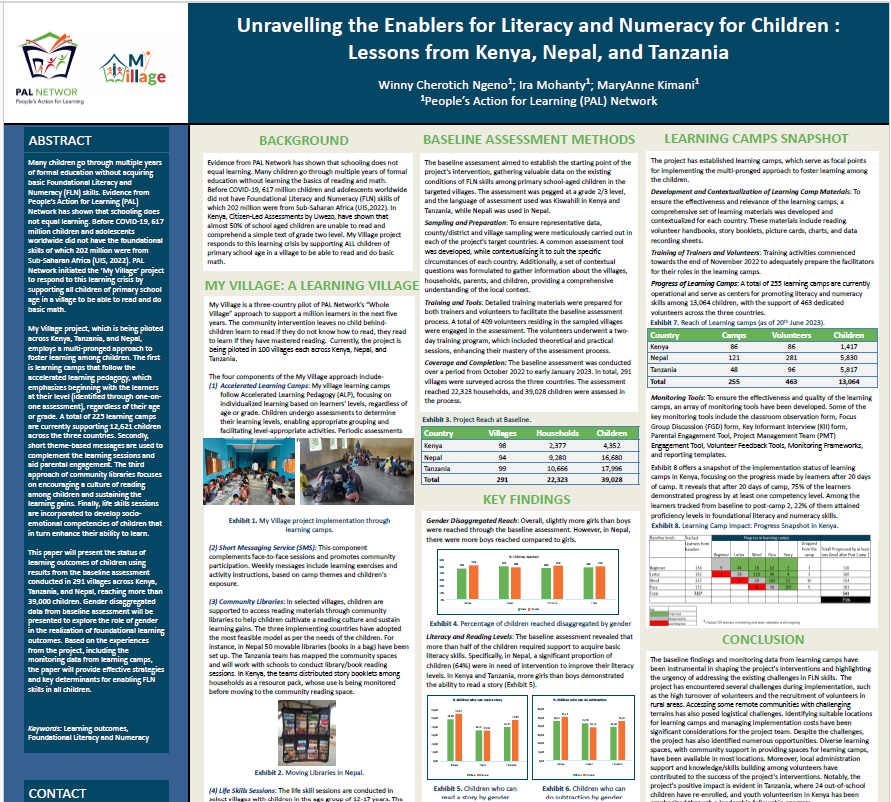
Many children go through multiple years of formal education without acquiring basic Foundational Literacy and Numeracy (FLN) skills. Evidence from People’s Action for Learning (PAL) Network has shown that schooling does not equal learning. Before COVID-19, 617 million children and adolescents worldwide did not have the foundational skills of which 202 million were from Sub-Saharan Africa (UIS, 2022). PAL Network initiated the ‘My Village’ project to respond to this learning crisis by supporting all children of primary school age in a village to be able to read and do basic math.
My Village project, which is being piloted across Kenya, Tanzania, and Nepal, employs a multi-pronged approach to foster learning among children. The first is learning camps that follow the accelerated learning pedagogy, which emphasizes beginning with the learners at their level (identified through one-on-one assessment), regardless of their age or grade. A total of 225 learning camps are currently supporting 12,621 children across the three countries. Secondly, short theme-based messages are used to complement the learning sessions and aid parental engagement. The third approach of community libraries focuses on encouraging a culture of reading among children and sustaining the learning gains. Finally, life skills sessions are incorporated to develop socio-emotional competencies of children that in turn enhance their ability to learn.
This paper will present the status of learning outcomes of children using results from the baseline assessment conducted in 291 villages across Kenya, Tanzania, and Nepal, reaching more than 39,000 children. Gender disaggregated data from baseline assessment will be presented to explore the role of gender in the realization of foundational learning outcomes. Based on the experiences from the project, including the monitoring data from learning camps, the paper will provide effective strategies and key determinants for enabling FLN skills in all children.